
“KE-007 was a victim of the cold war. Another casualty, always war’s first, was the Truth. The story of KE-007 will be remembered pretty much the way the Americans told it in 1983 and not the way it really happened. (…) The moral of the story is that all governments, including our own, lie when it suits their purposes. The key is to lie first.”
Alvin A. Snyder
Warriors of Disinformation
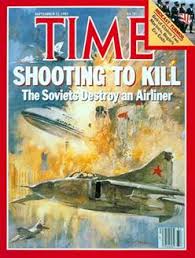
September 1 2023 — Korean Air Lines Flight 007 (also known as KAL 007) was a scheduled Korean Air Lines flight from New York City to Seoul. On September 1st 1983, the airliner serving the flight was shot down by a Soviet Su-15 interceptor, near Moneron Island west of Sakhalin in the Sea of Japan. President Reagan described the attack as a “massacre” and a “crime against humanity”. In fact, the US Intelligence Community knew full well that the Russians had not been able to identify the airliner and truly believed that it was a spy plane. The tape presented as evidence at the UN had been edited to remove 5′ documenting the relevant exchanges between the pilot and the Russian authorities. Follow us on Twitter: @INTEL_TODAY
Lockerbie — Three Decades of Lies: J’Accuse…!
QUICK NOTE — To make it easier for the readers to retrieve various chapters of my book, I have created a special page “Lockerbie” where all the links to the chapters will be listed with a brief description. You can access that page directly as it appears at the far right of the top bar of this blog.
Lockerbie — Three Decades of Lies: J’Accuse…!
RELATED POST: Suspicious Aviation Tragedies: Introduction
RELATED POST: Former CIA Director John McLaughlin Tells a Whopper: “We don’t blow up civilian airliners…”
RELATED POST: Suspicious Aviation Tragedies: 1970 Swissair Flight 330
RELATED POST: Suspicious Aviation Tragedies — Iran Flight 655 (July 3 1988)
RELATED POST: Suspicious Aviation Tragedies: Pan Am 103 ( Lockerbie – 21 December 1988 )
RELATED POST: Suspicious Aviation Tragedies: Aerolinee Itavia Flight 870 (USTICA-1980)
RELATED POST: NEVER FORGET — Suspicious Aviation Tragedies: 1961 — Ndola United Nations DC-6 crash [UPDATE: UN REPORT Sept 26 2017]
RELATED POST: Suspicious Aviation Tragedies: 1989 — UTA Flight 772 (September 19 1989)
“As a result of the Korean Air Lines affair you have read and heard more about my business in the past two weeks than I would desire.”
Lt. Gen. Lincoln D. Faurer,
speech to the National Military Intelligence Association,
Fort McNair, Washington, D.C., September 16, 1983.
UPDATE (Sept. 1, 2026) — On September 16, 1983, just two weeks after the Soviet shootdown of Korean Air Lines Flight 007, NSA Director Lt. Gen. Lincoln D. Faurer spoke at Fort McNair, Washington, D.C.
“As a result of the Korean Air Lines affair you have read and heard more about my business in the past two weeks than I would desire.
For the most part, this has not been a matter of unwelcome leaks. It is the result of a conscious, responsible decision to address an otherwise unbelievable horror.
The risk was taken and some penalty must certainly be paid, in the sense of the intelligence that has been made available.
My intention, and that of the intelligence community, is that it’s now time to circle the wagons and stop talking.”
Faurer made clear that further disclosures could compromise intelligence “sources and methods.”
He then turned to the question of declassifying cryptographic history, warning that even some World War II material still contained information that “shouldn’t be said.”
Was any of the cryptographic history Faurer was protecting connected to Hagelin, Crypto AG, or the secret exploitation of Crypto AG machines?
James Bamford’s The Puzzle Palace, published in September 1982, identified references to the “Boris project” in correspondence between NSA cryptologist William F. Friedman and Boris Hagelin.
In 1983, the NSA moved to reclassify the Friedman papers. NSA records later revealed that 29 of the classified documents were letters between Friedman and Hagelin or a Hagelin associate.
Eighteen of those documents had previously been restricted, opened without authorization in 1979, and then closed again in April 1983.
The papers were eventually released, heavily redacted, and thousands of pages were made public by the NSA in 2015.
The chronology is striking: Bamford’s book appeared in 1982; the Hagelin/Friedman papers were reclassified in 1983; and, on September 16, 1983, NSA Director Lt. Gen. Lincoln D. Faurer warned that even some World War II cryptographic history still contained information that “shouldn’t be said.”
END of UPDATE
“Governments lie. They do it all the time. And, much as we’d like to believe otherwise, the US government is no exception. There were times when we may have believed otherwise. But after Vietnam and Watergate, we know better.”
US Journalist Ted Koppel
“The USS Vincennes: Public War, Secret War.”
ABC News (July 1st 1992)
UPDATE (September 1st 2023) — Truth Is the First Casualty in War
On this sad anniversary, I thought that it would be wise to remember that the White House has a long and not very distinguished history of lying, notably about the Russians.
Perhaps, the history of Korean Air Lines Flight 007 is the best documented case. President Reagan immediately described the attack as a “massacre” and a “crime against humanity”.
In fact, the NSA had correctly told the US President that the Russians had not been able to identify the airliner and truly believed that it was a spy plane, concluding: “The pilot did his job.”
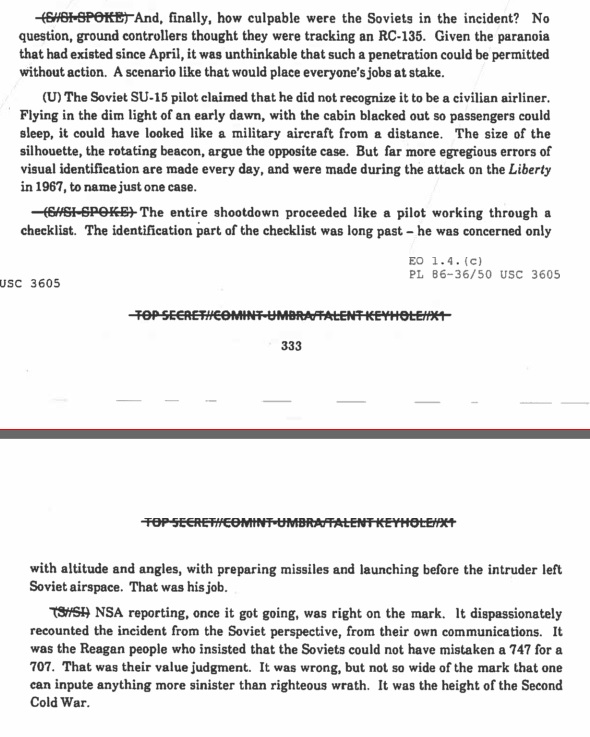
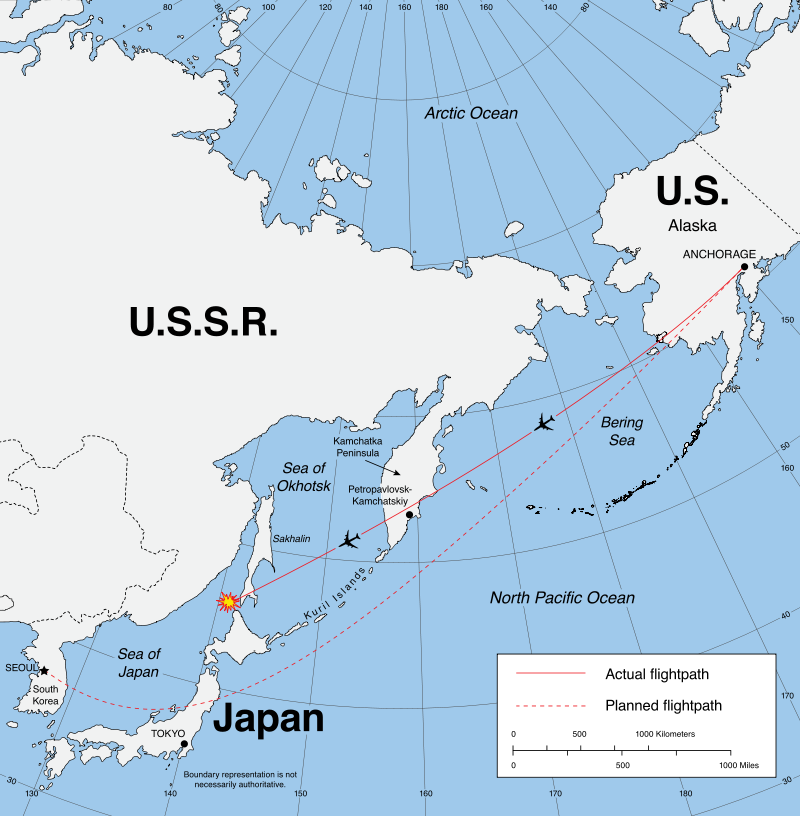
Today, the truth about this tragedy is well known and undisputed. During the flight, the KAL 007 pilots made a series of errors that brought the plane inside Soviet airspace.
If this mistake had been an isolated incident, it is entirely possible that the tragedy would not have occurred.
However, prior to that intrusion, American spy airplanes had repeatedly penetrated inside this highly sensitive area.
Instead of accepting the role of US agencies in this tragedy, the White House blamed the Russians.
I wonder how frequently innocent civilians lose their lives due to reckless espionage activities?
END of UPDATE
“We know they are lying, they know they are lying, they know we know they are lying, we know they know we know they are lying, but they are still lying.”
A. I. Solzhenitsyn
The interceptor’s pilot was Major Gennadi Osipovich. All 269 passengers and crew aboard were killed.
The Soviet Union initially denied knowledge of the incident, but later admitted shooting it down, claiming that the aircraft was on a MASINT [Measurement and signature intelligence] spy mission.
Washington — and the international community — claimed that the Soviet Air Force deliberately shot down the passenger liner.
“The first casualty when war comes is truth.”
Hiram Johnson
Speech, U.S. Senate. (1918)
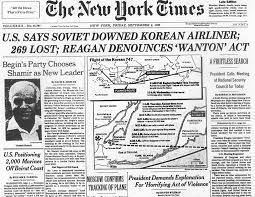
“There was absolutely no justification, either moral or legal, for what the Soviets did.”
President Reagan
President Reagan’s Address to the Nation on the Soviet Attack on KE-007
President Reagan described the attack as a “massacre” and a “crime against humanity”.
“Warriors of Disinformation”
In fact, the US knew full well that the Russians had not been able to identify the airliner and truly believed that it was a spy plane.
The tape presented as evidence at the UN had been edited to remove 5′ documenting the relevant exchanges between the pilot and the Russian authorities.
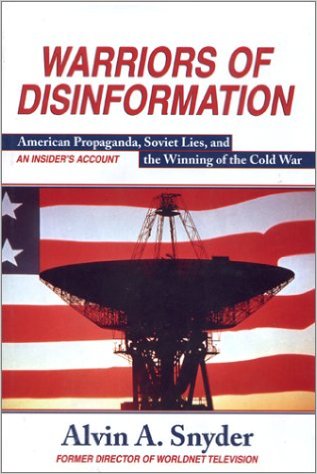
In his book “Warriors of Disinformation” (Chapter IV : The Five-Minute Tape Gap), Alvin A. Snyder wrote the following:
The moral of the story is that all governments, including our own, lie when it suits their purposes. The key is to lie first.
Izvestia correspondent Alexander Shalnev told me that our media show at the United Nations had been the most devastating propaganda blow his country received from the United States during the cold War.
“The most important rule in propaganda is to get the first word out on a given subject,” said Shalnev.
“Ninety percent of the time, the person who take the initiative wins the battle. You guys said the first word about the Korean airliner. And we lost it completely. It was devastating, terribly devastating.”
KE-007 was a victim of the cold war. Another casualty, always war’s first, was the Truth.
The story of KE-007 will be remembered pretty much the way the Americans told it in 1983 and not the way it really happened.
Lawsuit
Founded in 1950, Kreindler is the largest plaintiffs’ aviation law firm in the United States.
Two of the firm’s attorneys were appointed to the Committee that tried the case.
They meticulously detailed the series of errors made by the pilots during the flight, won a verdict of willful misconduct against the airline and successfully defended the verdict on appeal.
Post-Scriptum
In the aftermath of the KE-007 disaster, the US Air Force was asked how they would react if a civilian airliner was invading their airspace.
The answer was clear:
“It certainly would not be up to the pilot to decide what action to take.
That decision would have to be made at the Pentagon level, or at an even higher level.
Under no circumstances, would the American military shoot down such an aircraft, even were attempts to communicate with it unsuccessful.
Planes would be sent to investigate and the intruder aircraft would be escorted to land.”
On July 3rd 1988, the USS Vincennes mistook Iran Flight 655 for a military aircraft. The warship opened fire, killing all 290 persons aboard.
President Reagan described the incident as “tragic but understandable”.
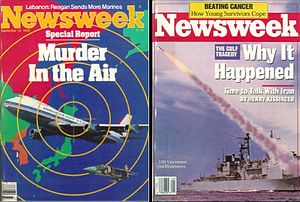
On the campaign trail, Vice-President Bush promised that he would never apologize for this incident.
Air Crash Investigation – Soviet Fighter Shot Down Commercial Korean Airline 007
REFERENCES
A Powerful Russian Weapon: The Spread of False Stories — NYT August 28 2016
Korean Air Lines Flight 007 transcripts
=
40 Years Ago — Korean Airliner Flight 007 Shot Down (September 1 1983) [UPDATE : Truth Is the First Casualty in War]

