
“Now, when we magnify the photograph of the label, Mr. Gilchrist, we can see, can we not, that it has been altered?”
“I can see writing underneath it.”
“Exactly. And if we look carefully at the writing underneath the word ‘debris,’ we can make out, can we not, the word ‘cloth,’ with the C being under the D, the L under the E, an O under the B of ‘debris,’ and a T under the R, and a H under the S?”
“It’s possible, yes, sir.”
“It’s more than possible, Mr. Gilchrist. It’s perfectly obvious, isn’t it?”
“Yes.”
— Transcript of the Lockerbie trial
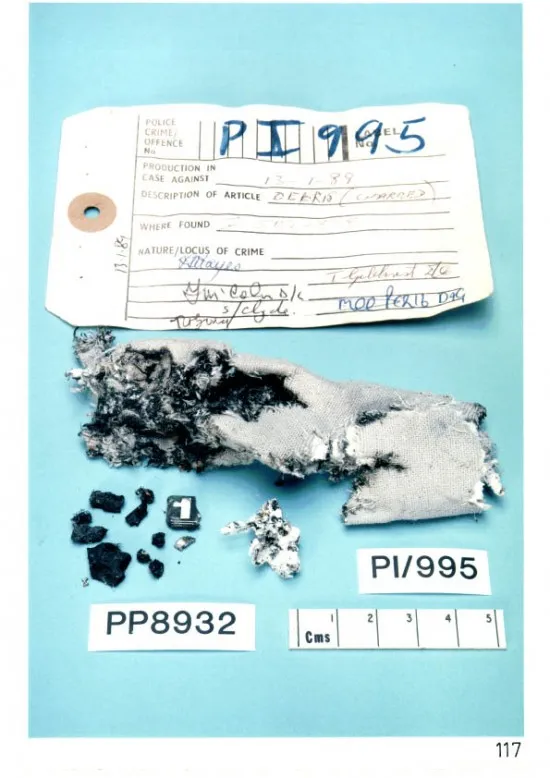
August 29, 2026 — The August 11 court filing in the Masud case has brought an apparently mundane issue to the forefront: the importance of the evidence tags attached to the physical evidence. The prosecution argues that these tags help demonstrate that the evidence was handled according to rigorous procedures and can establish the origin and integrity of the items. The defence takes a fundamentally different view. Follow us on Twitter: @INTEL_TODAY
RELATED POST : Did Intel Today Trigger the Halt of the Lockerbie Trial?
RELATED POST : Lockerbie 30th Anniversary — PT/35(b) : The Fairy Tale of the Togo Timers
RELATED POST : Lockerbie — CIA’s Adventures in Africa : Senegal Shenanigans [UPDATE — Lockerbie Trial : The Senegalese evidence]
RELATED POST : On This Day — Gaddafi Target of U.S. Disinformation (October 2 1986 — Bob Woodward) [Disinformation Goes Mainstream]
The existence of a tag proves little by itself. What matters is what the tag actually says — who found the item, where and when it was found, how it was handled, and whether those entries can be authenticated.
If a tag is inaccurate, altered, incomplete, or cannot be properly authenticated through the people who created it, it cannot simply be treated as a shortcut to establishing provenance and chain of custody.
And this seemingly technical legal dispute may have profound implications for the most important piece of physical evidence in the Lockerbie case: PT/35(b).
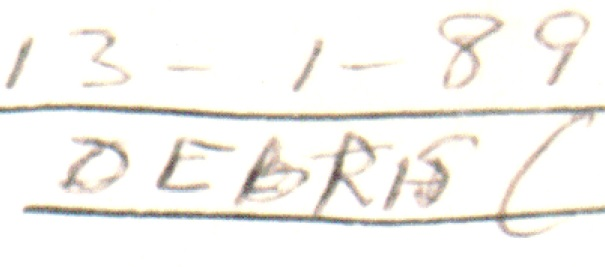
The original inscription on the label was “CLOTH.”
The word “cloth” was subsequently overwritten with the word “DEBRIS.”
According to the Lockerbie judges:
“There was no satisfactory explanation as to why this was done, and DC Gilchrist’s attempts to explain it were at worst evasive and at best confusing.”
Nearly four decades later, the same evidence tag has become the subject of a legal dispute in the Masud trial.
What was supposed to be evidence of a crime has turned into a crime of evidence.
“It’s like you’re not telling me something.”
Judge Dabney Friedrich
August 19, 2026
Timeline
August 11, 2026 — The government and defence file competing submissions concerning the use and significance of evidence labels.
August 19, 2026 — Judge Dabney Friedrich raises serious concerns about the prosecution’s handling and authentication of evidence.
August 20, 2026 — Intel Today publishes a warning about the provenance of PT/35(b).
August 21, 2026 — Previously unknown evidence comes to light.
August 22, 2026 — Abu Agila Masud’s defence team receives the evidence.
August 24, 2026 — Judge Friedrich grants the defence motion to continue and vacates the August 26 trial date. The court cites “newly discovered evidence” and the need for the defence to determine how best to defend the case.
September 1, 2026 — A status conference is scheduled to determine the next steps in the case.
REFERENCES
U.S. District Court for the District of Columbia, “Government’s Response to Defense’s Response to the Court’s July 31, 2026 Minute Order,” United States v. Abu Agila Mohammad Mas’ud Kheir Al-Marimi, No. 22-cr-392 (DLF), August 11, 2026.
=
Legal Dispute over Lockerbie Evidence Tags
“As an afterthought I think that had the original Scottish Police Investigators obeyed their political masters by introducing the fragment into the chain of evidence in or around December 1989 then they may have got away with the deception but due to the fact that they chose to alter Forensic notes and photographs and change production labels and attribute Memos in relation to other pieces of evidence to PT/35(b) it was fairly easy to pick holes in their case.”
Lockerbie Investigator George Thomson
(Email to Intel Today)

