
“The 56 stars carved into the wall here in this lobby remind each who passes by this place of the ultimate risks of intelligence work.”
President Bill Clinton
CIA Headquarters
(January 4, 1994)
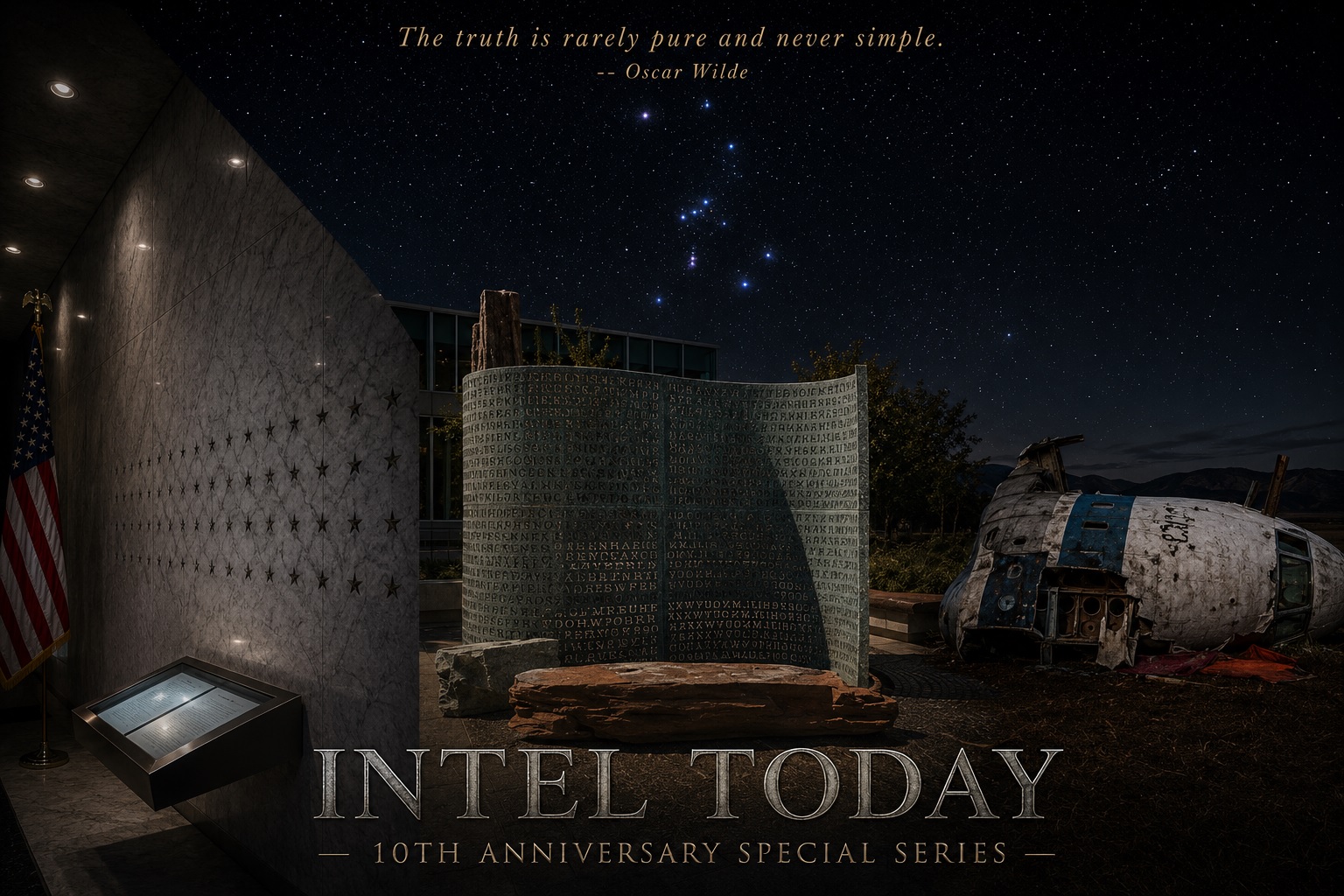
July 6, 2026 — Over the last three decades, I have devoted much time to several distinct stories: the CIA Memorial Wall (and the associated Book of Honor), the KRYPTOS sculpture, and the Lockerbie tragedy. In my wildest dreams, I never expected that these stories would one day come together. Follow us on Twitter: @INTEL_TODAY
RELATED POST : Lockerbie 30th Anniversary — PT/35(b) : MEBO TELECOM and the Story of the MST-13 Timers
RELATED POST : CIA Annual Ceremony — 50th Anniversary of the Memorial Wall (May 17, 2024) [UPDATE — Earliest known photo of the CIA Memorial Wall]
This article is the third installment in our series. Readers may benefit from reviewing the previous articles for a better understanding of the topics discussed here.
RELATED POST : The Holy Grail — The CIA Wall, The KRYPTOS Sculpture, & The Lockerbie Tragedy
Bill Clinton visited the Central Intelligence Agency on three occasions (January 4, 1994; July 14, 1995; and September 16, 1997).
Any presidential visit to the Agency is, of course, an important event. However, for those studying the history of the Memorial Wall, the first and third visits are particularly interesting.
Misinformation from Wikipedia
Writing about the CIA Memorial Wall is exceptionally challenging. Information about the stars is scarce, disinformation is plentiful, and misinformation appears to be everywhere.
The following example illustrates the problem. According to Wikipedia’s article on the 1993 CIA headquarters shooting:
“Bennett and Darling were memorialized as the 69th and 70th entries on the CIA’s memorial wall of stars in the foyer of the Langley headquarters building, although President Clinton, in an address to the CIA, attributed the two individuals as the 55th and 56th stars. His statement was read during a memorial service at CIA headquarters by the First Lady, Hillary Rodham Clinton.”
First Lady Hillary Rodham Clinton did not read the statement; President Clinton delivered the speech in person.
RELATED POST : On This Day — “What a Hornets’ Nest I had Stirred!” [Wikipedia edited by the CIA – July 26 2007]
Furthermore, he did not attribute any of the stars on the Memorial Wall to specific individuals. Finally, Bennett and Darling are not the 69th and 70th entries in the Book of Honor.
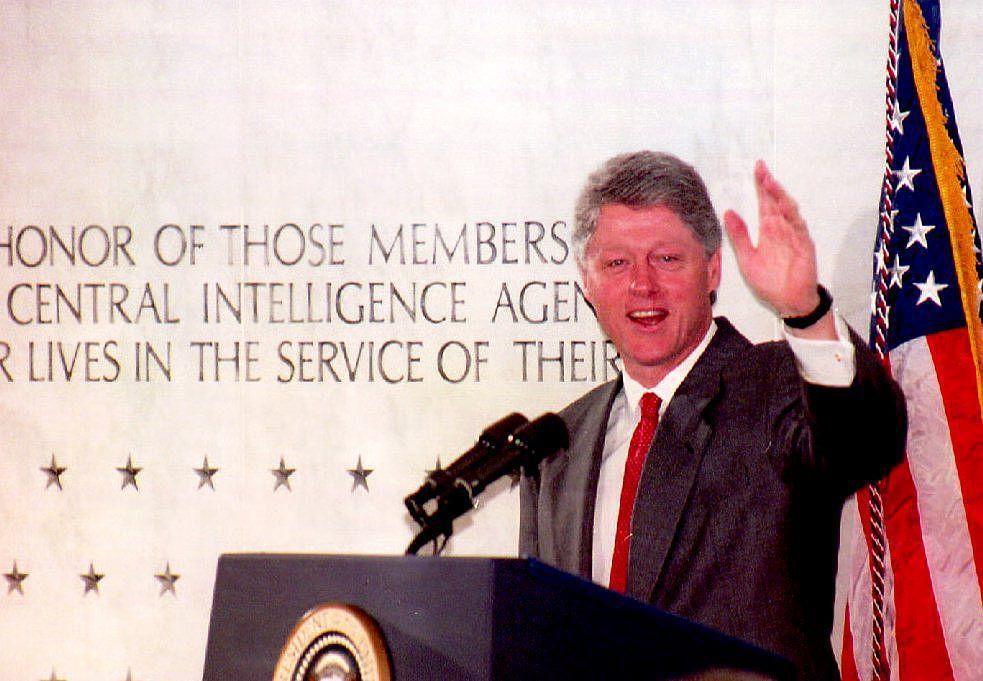
On January 4, 1994, President Clinton spoke to CIA employees in the main lobby, but not directly in front of the stars. Instead, he stood to the left side of the Memorial Wall, in front of the American flag.
During his address to CIA employees, Bill Clinton acknowledged the inherent dangers of the post–Cold War era and praised officers for the risks they take to keep the nation safe.
He referred directly to the significance of the CIA’s Memorial Wall, noting:
“The 56 stars carved into the wall here in this lobby remind each who passes by this place of the ultimate risks of intelligence work. (…) Two of the stars added just this year commemorate two devoted agency professionals who were slain last January entering this compound — Dr. Lansing Bennett and Frank Darling.”
In my previous post, I explained that the Book of Honor contained 49 stars before the addition of the star commemorating William Buckley in 1985.
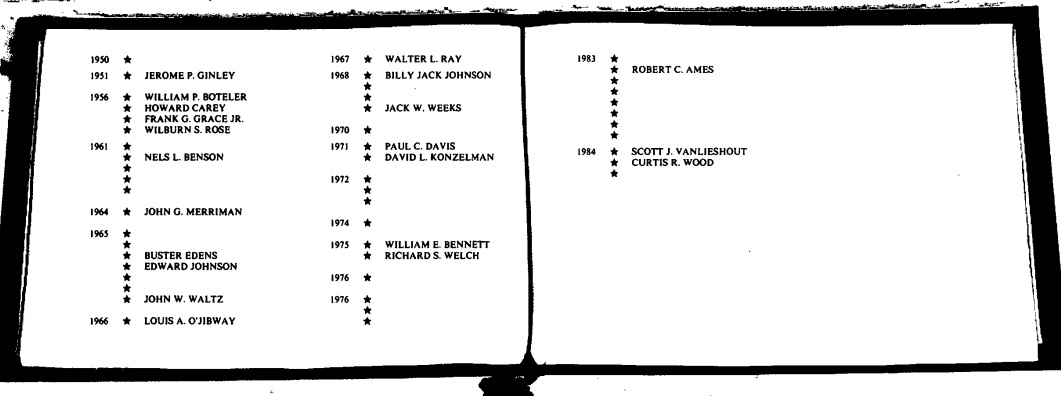
From President Clinton’s remarks, we know that six stars were added to the Memorial Wall between 1985 and January 1994, including the two commemorating Bennett and Darling.
The question, then, is: which four stars account for the remainder? Let us examine the evidence and identify the possible additions to the Memorial Wall during that period.
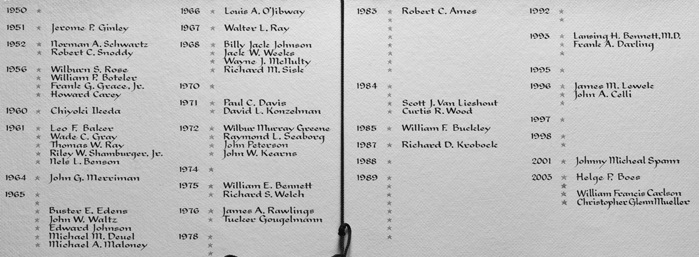
A comparison of the 1994 Book of Honor with the 2004 edition allows us to compile a complete list of the candidates.
Before doing so, however, we must exclude the stars that were added retroactively to both the Memorial Wall and the Book of Honor:
Chiyoki Ikeda (star added in 1997)
Norman A. Schwartz and Robert C. Snoddy (stars added in 1998)
Raymond L. Seaborg (star added in 1999)
Tucker Gougelmann (star added in 2001)
Consequently, the four missing stars must be among the following fourteen:
1984 — One officer whose identity remains classified
1987 — Richard D. Krobock
1988 — Matthew K. Gannon
1989 — Eight stars: Robert W. Woods, six officers killed in Angola, and one officer whose identity remains classified
1992 — Barry S. Castiglione and Lawrence N. Freedman
1993 — Freddie Woodruff
We can probably rule out the six officers killed in Angola, as it is likely they were memorialized as a single group.
Even if we also set aside Freddie Woodruff (September 14, 1947 – August 8, 1993) due to the timing of his death, we are still left with seven candidates for four stars.
At this point, there are too many unknowns, and without additional evidence, we cannot make further progress.
Strangely enough, the next clue comes from Kryptos, the iconic sculpture by American artist Jim Sanborn on the grounds of Central Intelligence Agency Headquarters.
REFERENCES
The White House, Office of the Press Secretary. Remarks by the President to Central Intelligence Agency Employees. January 4, 1994. CIA Headquarters, Langley, VA.
=
The Holy Grail — The CIA Wall, The KRYPTOS Sculpture, & The Lockerbie Tragedy — Part II : President Bill Clinton visits the CIA (January 4, 1994)
“Chance favors the prepared mind.”
Louis Pasteur

