
“Despite a government-wide rescue effort, Bill died in captivity on June 3, 1985. The CIA that year held a memorial service and honored him with a star on the Memorial Wall and with the Distinguished Intelligence Cross, the CIA’s highest honor.”
William F. Buckley
CIA website
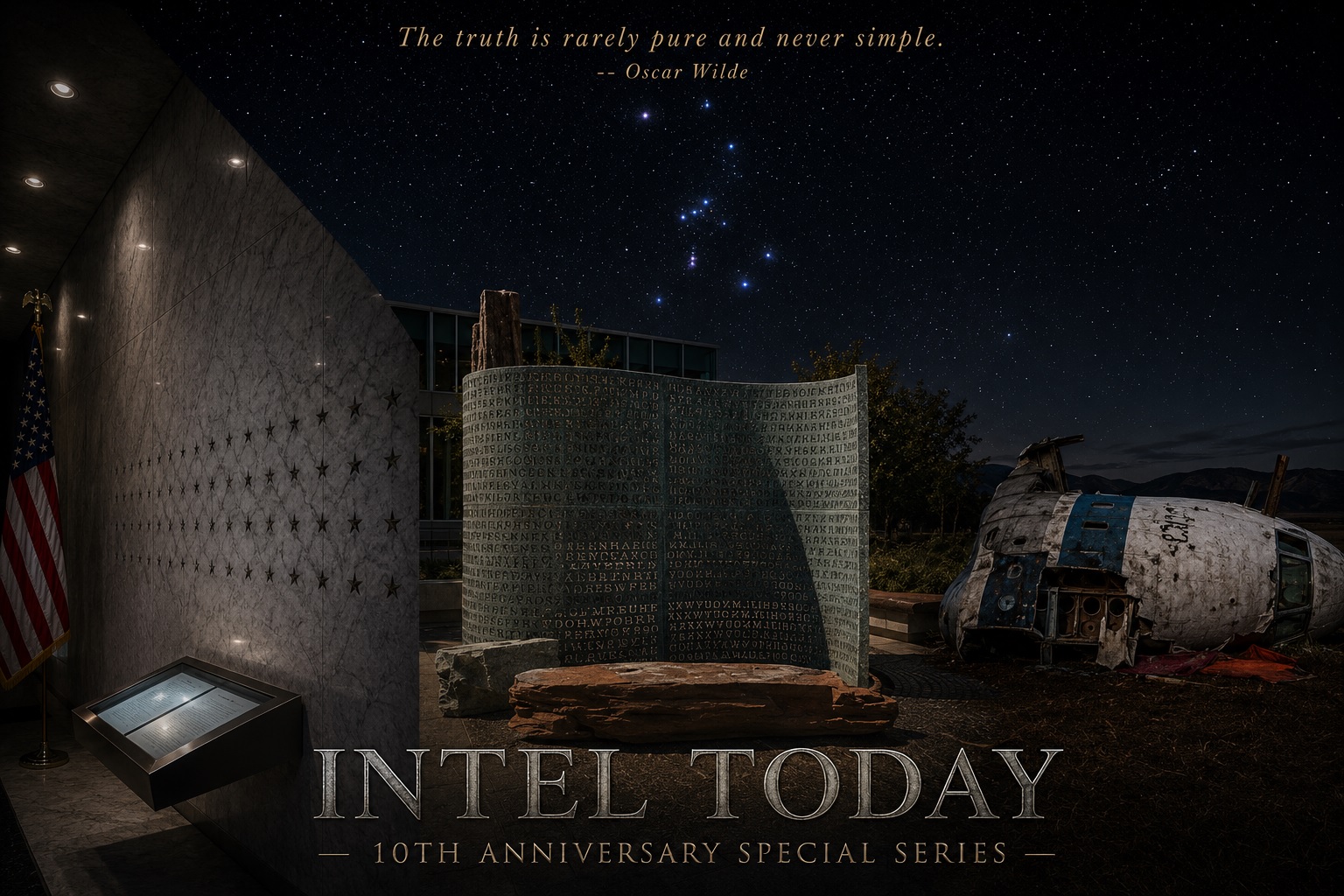
June 29, 2026 — Over the last three decades, I have devoted much time to several distinct stories: the CIA Memorial Wall (and the associated Book of Honor), the KRYPTOS sculpture, and the Lockerbie tragedy. In my wildest dreams, I never expected that these stories would one day come together. Follow us on Twitter: @INTEL_TODAY
RELATED POST : The Holy Grail — The CIA Wall, The KRYPTOS Sculpture, & The Lockerbie Tragedy
RELATED POST : Lockerbie 30th Anniversary — PT/35(b) : MEBO TELECOM and the Story of the MST-13 Timers
RELATED POST : CIA Annual Ceremony — 50th Anniversary of the Memorial Wall (May 17, 2024) [UPDATE — Earliest known photo of the CIA Memorial Wall]

In the Beginning
Earlier this month, I was drafting a short story about CIA paramilitary operations officer William Francis Buckley (May 30, 1928 – June 3, 1985) when I came across an issue that gave me pause.
Buckley is buried at Arlington National Cemetery and is commemorated with a star on the CIA Memorial Wall. According to some sources, including Wikipedia, “the 51st star on the CIA Memorial Wall represents him.”

That simple statement raises a few issues. First of all, the CIA Memorial Wall’s stars are not officially numbered. When Harold Vogel designed the memorial, “his vision of the CIA’s Memorial emphasized the unity of the stars on the Wall, standing as a field.”
Yet over the years, historians, journalists, and even CIA directors have come to associate individual fallen officers with particular stars.
For instance, during the 2007 CIA Memorial Ceremony, Director Michael Hayden stated: “Rachel was a warm and compassionate young woman, and an officer of unbounded potential. We miss her still and will remember her always. She is our 87th star.”
This is, of course, only human. Family members who witness a sculptor chiseling a new star into the wall inevitably come to associate that particular star with their loved one.
Next comes the question of methodology. What exactly does it mean to call Buckley “the 51st star”? Does the number refer to the chronology of officers’ deaths, or to the sequence in which stars were added to the wall?
The Wikipedia page for Francis Buckley does not say, but we can safely conclude that the former explanation cannot be correct. Indeed, Wikipedia was launched on January 15, 2001, and we know that the CIA Memorial Wall already commemorated more than fifty officers who had died before Buckley.
Thus, the only possible reading of the statement is that Francis Buckley’s star was the 51st added to the wall. And this is precisely what gave me pause. How would one know that the Buckley star was the 51st added? Is the claim documented anywhere? Is it even true?
To understand my reaction, the reader must know that it is very difficult to determine when stars were added to the wall between 1974 and 2000.
First, there was no memorial ceremony until 1987. Second, even after ceremonies began, the CIA rarely issued press releases. Third, during that period, the Agency began adding stars retroactively, as in the case of Chiyoki Ikeda, who died on March 17, 1960, but was commemorated nearly forty years later.

The original 31 stars
The Memorial Wall was created in July 1974. Thirty-one stars were chiseled into the marble, and thirty-one entries were inscribed in the Book of Honor. Sixteen were accompanied by a name, while the others remained anonymous.
There was no dedication ceremony, and no photographs were taken. The earliest known photograph of the Book of Honor already shows two additional stars, commemorating officers who died in 1975.
“When I joined CIA in August 1980, there were 38 stars on this wall. Less than three years later, when Hizballah terrorists bombed the US Embassy in Beirut, [REDACTED/EIGHT] stars would be added in one single day.”
John O. Brennan
CIA Memorial Ceremony
20 May 2013
The Toll Rises to 38 Stars
According to CIA Director John Brennan, there were 38 stars on the Memorial Wall when he joined the Agency in August 1980.
An old photograph of the Book of Honor — taken around 1985 — confirms this information.

This version of the book contains a few errors. Most notably, the three stars at the bottom of the second column should be dated 1978, not 1976.
Nevertheless, we can safely conclude that seven stars were added between July 1974 and August 1980 (one for 1974, two for 1975, one for 1976, and three for 1978) bringing the sum from 31 to 38.
“By the time of the first ceremony (1987) the number of stars had grown to 50.”
Sacred Stars
CIA’s Memorial Wall Turns 50
(July 2024)
The 1987 Memorial Ceremony
On May 27, 1987, the CIA held its first annual Memorial Ceremony. By then, the Memorial Wall counted 50 stars.
On April 18, 1983, eight CIA officers died in the Beirut embassy bombing. On October 18, 1984, three CIA employees were killed in a plane crash while on a covert mission during the Salvadoran Civil War.
If we add these eleven stars to the previous total of 38, the number rises to 49.

“Despite a government-wide rescue effort, Bill died in captivity on June 3, 1985. The CIA that year held a memorial service and honored him with a star on the Memorial Wall.”
WILLIAM F. BUCKLEY
CIA Website
The Star of William Buckley
In 1985, the CIA added a star to the Memorial Wall to commemorate William Buckley.
Prior to the addition of that star, the wall already counted 49 stars. By the time of the first annual Memorial Ceremony in 1987, it counted 50.
The conclusion is inescapable: William Buckley’s star was the 50th added to the Memorial Wall.
Quo vadis?
The claim that Buckley was the “51st star” does not withstand scrutiny. The evidence places his star as the 50th added to the Memorial Wall.
But a curious mind does not stop at a single correction. Having reconstructed the sequence between stars 31 and 50, it is natural to ask whether a similar approach might shed light on the later additions — particularly the sequence of stars from 51 to 79, ending with Johnny “Mike” Spann, the first CIA officer killed in the aftermath of 9/11.
On January 4, 1994, President Bill Clinton visited the Central Intelligence Agency headquarters in Langley, Virginia. During his address to CIA employees, he acknowledged the inherent dangers of the post–Cold War era and praised officers for the risks they took to keep the nation safe.
Speaking in front of the Memorial Wall — the first time a sitting U.S. president had done so — Clinton made a brief reference to two recently added stars. That single detail suggests that the chronology of the Wall may still be partially recoverable. This is where the next inquiry begins.
REFERENCES
Central Intelligence Agency. “HEROES — WILLIAM F. BUCKLEY”
Central Intelligence Agency. “Sacred Stars: CIA’s Memorial Wall Turns 50.”
=
The Holy Grail — The CIA Wall, The KRYPTOS Sculpture, & The Lockerbie Tragedy — Part I : Getting started [The STAR of William Francis Buckley (May 30, 1928 – June 3, 1985)]
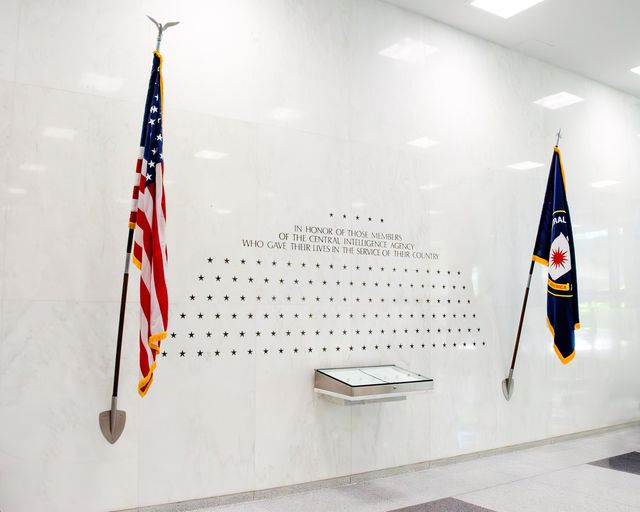
“Fifty years ago, #CIA created the Memorial Wall to honor its fallen heroes. Today, CIA remembered 140 lives lost in service to their country during the annual Memorial Ceremony.”
CIA Facebook
May 17, 2024

