“In the preliminary analysis conducted within hours of the event, NORSAR reported an event magnitude of 5.8. This estimate was obtained using analysis procedures developed from investigations of the previous five North Korean test explosions, all of which were around the magnitude range 4 – 5.
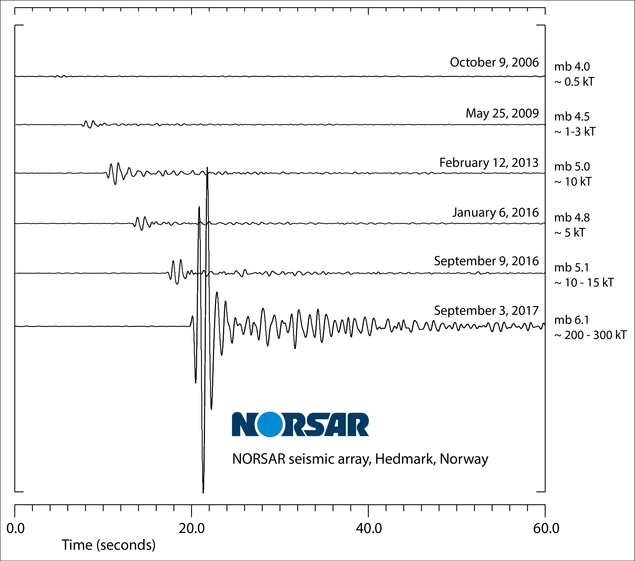
However, the 3 September 2017 test was an order of magnitude larger than any of the previous explosions and resulted in seismic signals dominated by radiated energy at lower frequencies. Our analysis procedures have been revised accordingly to include the lowermost part of the signal spectrum. The revised assessment estimates the magnitude to 6.1 and makes this explosion clearly the strongest so far.”
NORSAR

The figure shows to a common scale the signals from the six North Korean nuclear tests and their magnitudes after applying the revised analysis procedures to data from the NORSAR seismic array station in Hedmark, Norway. The trace at the bottom shows the signal from the 3 September 2017 event, whereas the five upper traces display the signals from the five preceding tests, conducted by North Korea in 2006, 2009, 2013, and 2016 (two explosions).
NORSAR and 38NORTH have revised their initial yield estimate for the magnitude of the event on 3 September 2017. This new estimate — mb = 6.1 and a yield of about 250 kilotons TNT — is significantly higher than the yield previously suggested. In comparison, the explosive yield of the nuclear bomb dropped on Hiroshima on 6 August 1945 was estimated at approximately 15 kilotons TNT, while the bomb dropped on Nagasaki three days later was estimated at approximately 20 kilotons TNT. However, depending on the burial depth of the explosion, the yield could be significantly higher than currently reported. A yield as high as 500 kt cannot be ruled out. Follow us on Twitter: @INTEL_TODAY Continue reading →









 Intel Today