
“Fake news has become a catch-all term for misinformation, disinformation, and malinformation, but its defining feature is that it mimics news media in form but not in organizational process or intent.”
Lazer et al., Science (2018)
June 28, 2025 — We’ve all heard it: “You can’t tell truth from lies anymore.” Some of my friends—one of them a seasoned FBI investigator—insist we now live in a “post-truth” era. That the average person is defenseless against manipulation. Well, that’s simply not true. Follow us on Twitter:@INTEL_TODAY
RELATED POST : On This Day — Gaddafi Target of U.S. Disinformation (October 2 1986 — Bob Woodward) [Disinformation Goes Mainstream]
RELATED POST : CIA Memorial Wall — How many CIA officers died during Trump’s Presidency? [Disinformation]
“Be very, very careful what you put in that head, because you will never, ever get it out.”
Cardinal Thomas Wolsey
To understand the problem of fake news, we must first ask the right questions. As the old saying goes: “Asking the question correctly is half the work of answering it.”
And so, researchers have zeroed in on two deceptively simple questions:
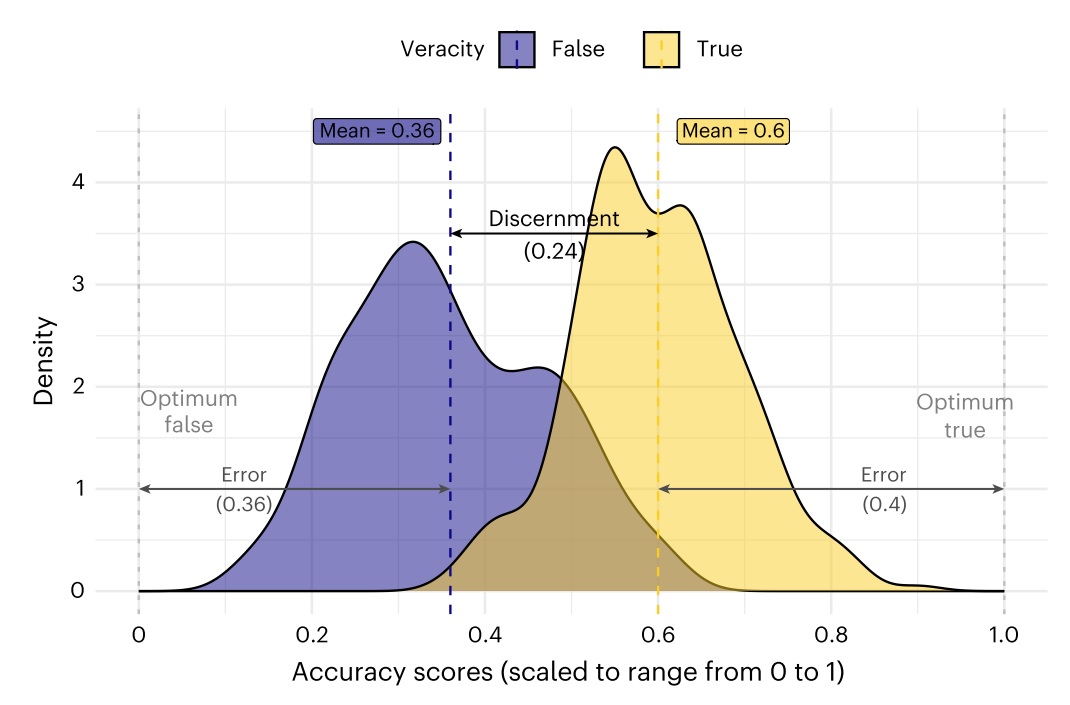
1) Do people tend to rate true news as more accurate than false news? (This is called discernment.)
2) Are people better at recognizing false news as false than they are at recognizing true news as true? (This is known as a skepticism bias.)
A sweeping meta-analysis—covering data from 40 countries across 6 continents — looked for answers. (Unfortunately, no North African countries were included.) Yet the findings are striking and globally relevant:
Result 1: People do rate true news as more accurate than false news. In other words, we can tell the difference. Discernment is real.
Result 2: People are better at spotting false news than affirming true news. That’s the skepticism bias: a tendency to err on the side of doubt.
A visual from the study makes this clear. The average accuracy ratings for true and false news are well separated, a solid indicator of discernment.
But when it comes to error margins, people are more often wrong about true news — being too skeptical — than they are about false news. That’s the bias.
“The very concept of objective truth is fading out of the world. Lies will pass into history.”
Orwell, 1943
So, what’s the takeaway?
While we may struggle with lies in personal interactions — because we rely on faulty cues like body language — when it comes to news, especially headlines or articles, we are not blind.
Our critical faculties still work — just not perfectly. In fact, we’re better at identifying lies than affirming truth.
We tend to be cautious, sometimes too much so… As Physics Nobel laureate Richard Feynman once remarked: “It is not prudent to be too prudent.”
In a world awash in misinformation, this is a hopeful message: We’re not helpless.
We just need to keep asking the right questions— and keep an open mind on what the truth might be.
“If we are not able to ask skeptical questions… then we are up for grabs for the next charlatan who comes along.”
Carl Sagan
Sources
Nature Human Behaviour — Spotting false news and doubting true news: a systematic review and meta-analysis of news judgement (Feb. 21, 2025)
=
Fake News, Real Questions
“The ideal subject of totalitarian rule is not the convinced Nazi or the convinced Communist, but people for whom the distinction between fact and fiction… no longer exists.”
Hannah Arendt (1974)
 Intel Today