
“Boeing planes don’t just fall out of the sky.”
The Bombing of Pan Am 103
Official Trailer
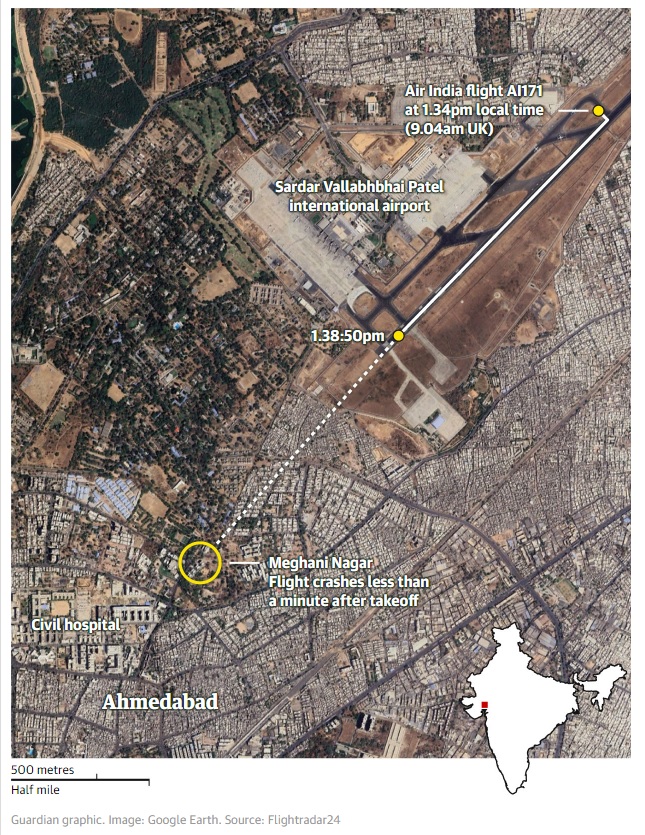
Friday June 13, 2025 — Every time a Boeing airliner crashes, the aftermath is never just about aviation safety — it becomes a battleground of national interests, political agendas, and intelligence maneuvering. Once again, the U.S. President will be pressured to shield Boeing by pointing fingers at terrorism, attempting to steer the narrative before the facts have fully emerged.
But the evidence already paints a starkly different picture: catastrophic mechanical and electrical failures, not external sabotage, brought down Flight AI171. This isn’t an isolated incident. As IntelToday has long warned, the cycle of tragedy will continue as long as the shadow over Pan Am 103 remains unlifted — a shadow that conceals uncomfortable truths about Boeing’s safety record and the limits of official narratives. The time has come to confront these truths head-on. Follow us on Twitter: @INTEL_TODAY
RELATED POST: On this Day — At Long Last, FBI Admits No Evidence of Foul Play in 1996 TWA 800 Crash (November 18 1997)
RELATED POST: Lockerbie — Why I ruled out the bomb theory [Technical Analysis of the Debris Lines]
RELATED POST: Boeing 747 : The End of an Era? [UPDATE : U.S. DoJ Non-Prosecution Agreement for Boeing Sparks Outrage]
“I am expecting a gold watch from Boeing at the end of my presidency for being a top salesman.”
President Obama
(July 21 2016)
On June 12, 2025, Air India Flight AI171, a Boeing 787-8 Dreamliner, crashed shortly after taking off from Sardar Vallabhbhai Patel International Airport in Ahmedabad, India. The aircraft was en route to London Gatwick Airport and was carrying 242 people, including 230 passengers and 12 crew members.
The crash happened about 30 seconds after departure, during the initial climb. Contact with air traffic control was lost at an altitude of 625 feet. The cause of the crash remains under investigation, with authorities from both India and the United Kingdom working together on the inquiry.
“I gave them a couple of pointers. I said, ‘Maybe you look at this,’ you know, we saw the plane, it looked like it was flying pretty well, it didn’t look like there was an explosion, just looked like the engines maybe lost power.”
Donald Trump
(June 12, 2025)
Flight AI171 Failure Timeline – A Systems Breakdown
Understanding the sequence of events that led to the tragic crash of Air India Flight AI171 is crucial for unraveling what really happened. Here’s a timeline based on the available data, highlighting critical system failures and pilot communications:
00:00 — Flight AI171 takes off from Ahmedabad’s Sardar Vallabhbhai Patel International Airport, a routine departure with all systems showing normal parameters.
00:15 — Seconds into the climb, an abnormal electrical “pop” sound is reported near the avionics bay beneath the cockpit. This likely signals the first major system failure.
00:18 — Flap and hydraulic systems begin to malfunction, compromising control surfaces and reducing lift capability. The aircraft’s instruments start showing inconsistent readings.
00:20 — Captain Sumeet Sabharwal, with over 8,200 flight hours, issues a mayday call: “No thrust, losing power, unable to lift.” This indicates a critical loss of engine power and flight control.
00:25 — Radio communications become sporadic and eventually drop completely, indicating a total loss of onboard electrical and communication systems.
00:30 — The plane rapidly loses altitude and crashes into the Meghani Nagar neighborhood, causing widespread destruction and numerous casualties.
Preliminary Assessment of the Cause
Based on the information currently available, the crash of Air India Flight AI171 appears to be the result of a catastrophic mechanical and electrical failure rather than external interference such as terrorism.
Key indicators include:
Reports of a loud electrical “pop” near the avionics bay shortly after takeoff, suggesting an electrical system fault.
Immediate malfunction of critical systems, including hydraulic and flap controls, which compromised the aircraft’s ability to maintain lift and control.
Loss of engine thrust as communicated by the captain during his final mayday call.
Complete loss of communication, likely due to the failure of onboard electrical and communication systems.
While investigations are ongoing, early evidence points toward systemic failures within the aircraft’s electrical and hydraulic systems as primary contributors to the disaster.
This raises important questions about Boeing’s design, quality control, and maintenance practices — issues that have long been shadowed by political and corporate interests.
Further analysis of the recovered black boxes and technical data will be essential to confirm these findings and prevent future tragedies.
Whistleblower Warnings: A Chilling Echo
Long before the tragic crash of Flight AI171, insiders within Boeing and affiliated maintenance teams had sounded alarms about critical safety issues — warnings that were often ignored or suppressed.
Several whistleblowers pointed to recurring problems with the 787’s electrical systems, citing design flaws and rushed manufacturing processes that compromised system integrity. Others flagged concerns about maintenance shortcuts and inadequate quality checks.
These warnings, largely buried beneath layers of corporate and political protection, resonate eerily with the sequence of failures observed during the AI171 crash — the electrical “pop,” system malfunctions, and total communication blackout.
The question now is whether these ignored warnings could have prevented the disaster, and what institutional barriers prevented transparency and accountability.
Addressing these whistleblower concerns is not just about uncovering past mistakes — it’s about ensuring that the lessons finally lead to real change, for the safety of every future flight.
Never Forget
At its core, fascism is not primarily about racism or xenophobia. As Benito Mussolini himself stated, fascism is best defined as corporatism — the fusion of government and powerful business interests.
The close relationship between Boeing and the U.S. government exemplifies this dynamic. The recent Department of Justice Non-Prosecution Agreement with Boeing highlights how corporate influence can shape political decisions, often at the expense of transparency and accountability.
This fusion raises serious concerns about whose interests are truly being served — and the price paid in public safety.
Stay tuned!
REFERENCES
What we know so far about the Air India flight 171 crash – a visual guide (The Guardian)
=
Air India Flight AI171 — The Long Cover-Up: From Megrahi to Meghani
“One thing however is worrying aviation observers in India and abroad, and that is the time being taken to complete the inquiry and inform an eagerly waiting aviation world about the reasons which caused Kanishka (Air India 182) to break up. The whole industry has huge stakes in the Boeing 747 and if, for example, it were found that structural defects or fatigue had caused the crash, the repercussions for world airlines would be disastrous. All 747’s would have to be grounded and checked for structural fatigue.”
Kanishka disaster: ‘Black box’ recovered,
investigators to probe what caused the crash
Ramindar Singh
(August 15 1985)



Such a great read, thank you for posting!
LikeLike