
“Agency heads at the time created a politically charged environment that triggered an atypical analytic process around an issue essential to our democracy.”
CIA Director John Ratcliffe
(July 2, 2025)
July 6, 2025 — This week, the CIA concluded a critical internal review casting serious doubts on the integrity of past intelligence narratives—highlighting strong circumstantial evidence that former CIA Director John Brennan played a central role in shaping, and possibly fabricating, key political allegations. Follow us on Twitter: @INTEL_TODAY
RELATED POST: The Russiagate Debacle — Bob Woodward : “Role Of Steele Dossier In Russia Probe Needs To Be Investigated”
RELATED POST: Two Years Ago — The Trump Dossier : Raw Intelligence or Clever Fabrication? — POLL [UPDATE — Chris Steele Gets Cold Feet]
RELATED POST: Intel Report Suspiciously Anachronistic
RELATED POST : Spygate — Will Former CIA Director John Brennan Go to Prison? [UPDATE : Brennan is in the cross-hairs of Durham’s investigation]
“Power tends to corrupt, and absolute power corrupts absolutely.”
Lord Acton
UPDATE (November 8, 2025) — Things are heating up. A federal grand jury has now issued subpoenas to John Brennan, Peter Strzok, and Lisa Page, all central figures from the Russia‑investigation era.
This development escalates scrutiny on the origins of the 2016 probe and the role of intelligence and law‑enforcement officials — potentially validating long-suspected concerns about internal conspiracies and misconduct.
The investigation is ongoing, and more subpoenas are expected, signaling a rapidly unfolding legal and political storm. End of UPDATE
“For in the same way you judge others, you will be judged, and with the measure you use, it will be measured to you.”
Matthew 7:2
UPDATE (October 27, 2025) — Full Circle in Langley: Brennan’s Judgment Day
On October 21, 2025, the House Judiciary Committee referred former CIA Director John Brennan to the Department of Justice, accusing him of making false statements to Congress during his 2023 testimony on the Steele dossier’s role in the 2017 Intelligence Community Assessment on Russian election interference.
Brennan quickly fired back, calling the referral politically motivated. In his own words:
“They don’t care about doing things the right way. They don’t care about the damage to me and my family.”
The remark is striking given Brennan’s past — particularly his role in the prosecution of former CIA officer John Kiriakou, who exposed the CIA’s use of torture.
Kiriakou was charged in 2012 with disclosing classified information, leaking details about waterboarding and other “enhanced interrogation” techniques, and mishandling classified documents.
Although many of the charges were reportedly baseless and the CIA knew it, Brennan argued to keep them in place, aware that the drawn-out legal process would inflict maximum pain.
Most charges were ultimately dismissed, and Kiriakou pleaded guilty to one count, serving two years in federal prison.
Now, Brennan finds himself on the receiving end of the same machinery he once helped turn against others — his words about personal and family damage echoing with bitter irony.
What goes around comes around. And in the shadowed world of intelligence and power, that truth lands with uncommon weight.
END of UPDATE
“Memory is a core component of human cognition and an essential skill for intelligence analysis.”
Memory Techniques in Intelligence Analysis (2025)
UPDATE (September 28, 2025) — Justice and Irony: Brennan’s Long Memory Meets Today’s Political Spotlight
The indictment of former FBI Director James Comey, filed just before the statute of limitations would have expired, is seen by some as a political vendetta.
Nonetheless, there is a legitimate case to be made. The court — if impartial — could vindicate either side. This could become, in effect, a test of whether the U.S. justice system still works independently in highly politicized cases.
Time will tell.
It seems an appropriate moment to reflect on the role of time in both justice and memory. Consider these quotes:
“The passage of time will never lessen our resolve to bring those responsible for this heinous act to justice. The United States has a long memory and an unwavering commitment to see that justice is done.”
— FBI Director Robert S. Mueller III, December 2013 (25th Anniversary of Lockerbie)
“Let there be no mistake. No amount of time or distance will stop the United States, and its partners in Scotland, from pursuing justice in this case. The U.S. government … have never relented, and will never relent, in the pursuit of justice.”
— Attorney General William P. Barr, Pan Am 103 / Lockerbie press conference, December 21, 2020 (32nd Anniversary of Lockerbie)
Time is also central in today’s unfolding legal and political landscape.
Other cases may follow Comey’s indictment, including potential legal action against former CIA Director John Brennan.
Brennan allegedly lied to Congress in May 2023 about the use of the Steele dossier in the January 2017 Intelligence Community Assessment (ICA). The statute of limitations for making false statements to Congress (18 U.S.C. § 1001) is typically five years from the date of the offense. Brennan is definitely not off the hook.
After Comey’s indictment, Brennan publicly urged Donald Trump to “move on” from what he called the “Russia collusion hoax.”
The irony is hard to miss: Brennan built his reputation on the CIA’s “long memory,” yet now he is asking the political world to forget and move on.
CIA leaders — and Brennan in particular — have echoed the general theme that the world is a small place, and U.S. intelligence agencies have a long memory.
Recent reporting sheds light on the pace of any potential action: National Review notes that as the decision on Comey’s charges looms, the investigation into Brennan appears to be stalling, suggesting the DOJ may prioritize Comey first.
Axios reported that the revocation of security clearances by Tulsi Gabbard has complicated possible prosecution efforts, as some witnesses relevant to Brennan’s case had their clearances revoked.
No hurry… There is plenty of time until May 2028.
END of UPDATE
“The information we are releasing today clearly shows there was a treasonous conspiracy in 2016 committed by officials at the highest level of our government… Their goal was to subvert the will of the American people and enact what was essentially a years‑long coup.”
DNI Tulsi Gabbard
July 18, 2025
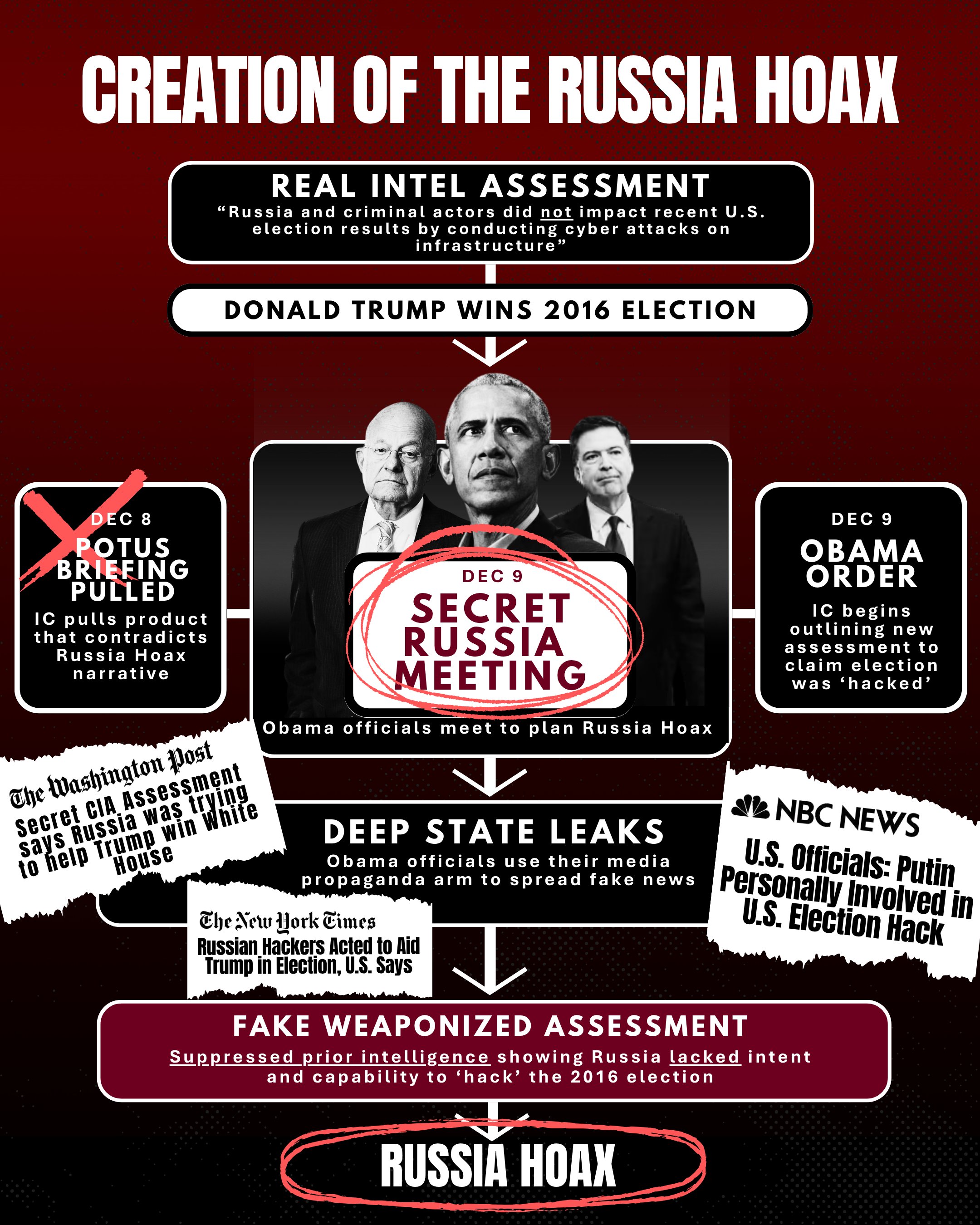
UPDATE (July 20, 2025) — In a bombshell revelation, Director of National Intelligence Tulsi Gabbard has released declassified documents showing that in late 2016, the U.S. intelligence community — under the direction of officials like CIA Director John Brennan — overrode internal analysis to promote a narrative of Russian election interference, heavily relying on the now-discredited Steele dossier.
According to Gabbard, a December 7, 2016 Presidential Daily Brief (PDB) concluded that Russia had not attempted to alter the outcome of the election. Yet just two days later, top Obama-era intelligence leaders met at the White House and initiated a new assessment that reversed those findings.
Gabbard alleges this shift laid the foundation for a “years-long coup” aimed at delegitimizing President-elect Trump, calling it a “treasonous conspiracy” and urging the Department of Justice to prosecute those responsible.
The Case Against John Brennan
At this point, the case against former CIA Director John Brennan appears less like speculation and more like a pattern of deliberate misjudgment, politicization, and manipulation. Here are the undisputed facts:
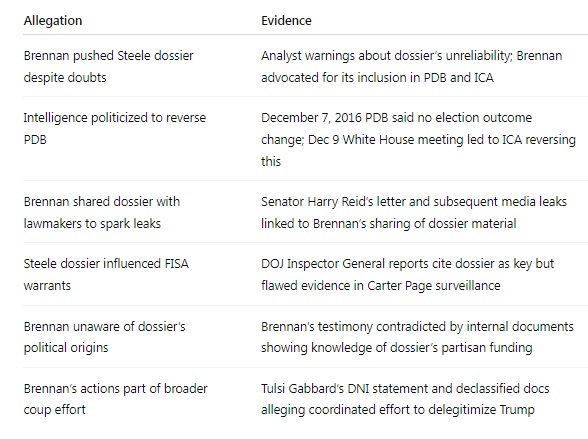
John Brennan was aware of the Steele dossier—a collection of unverified, opposition-funded allegations—by mid-2016. Despite repeated warnings from intelligence analysts that the dossier was uncorroborated and potentially tainted by disinformation, Brennan pushed to incorporate its contents into high-level briefings and assessments. In particular, he advocated for its inclusion in the intelligence community’s official analysis of Russian interference, known as the January 6, 2017 Intelligence Community Assessment (ICA).
Just days before that ICA was produced, the December 7, 2016 PDB had concluded that Russia “probably did not” alter any part of the election outcome, including through psychological operations. Yet on December 9, 2016, Brennan and other senior intelligence leaders met at the White House and, at President Obama’s direction, began work on a new assessment that reversed that conclusion. The result was a report that declared—without caveats—that Russia interfered in the election specifically to help Donald Trump win.
Simultaneously, Brennan shared Steele-related material with lawmakers such as Senator Harry Reid, triggering letters and leaks that laid the groundwork for a sweeping media narrative of “Trump-Russia collusion.” Shortly after the ICA was delivered, the Steele dossier itself was leaked, amplifying a politically explosive storyline based on material that intelligence officials had not verified.
Though Brennan later testified that the dossier was not central to the ICA, declassified records and oversight reports show that it influenced the framing of intelligence judgments at the most senior levels. Furthermore, that same dossier became a key piece of evidence in the FBI’s application for FISA surveillance of Trump advisor Carter Page—a process later deemed misleading and improper by the Department of Justice Inspector General.
While Brennan continues to defend his actions as necessary in the face of possible foreign threats, the factual record paints a starkly different picture: the CIA Director elevated unverified political research, ignored dissent within the intelligence community, and helped shape a narrative that fueled years of political and institutional turmoil.
Summary Table:
Allegations Against John Brennan
This isn’t about politics — it’s about rebuilding trust in intelligence agencies whose credibility is broken and holding those who abused their power accountable.
—
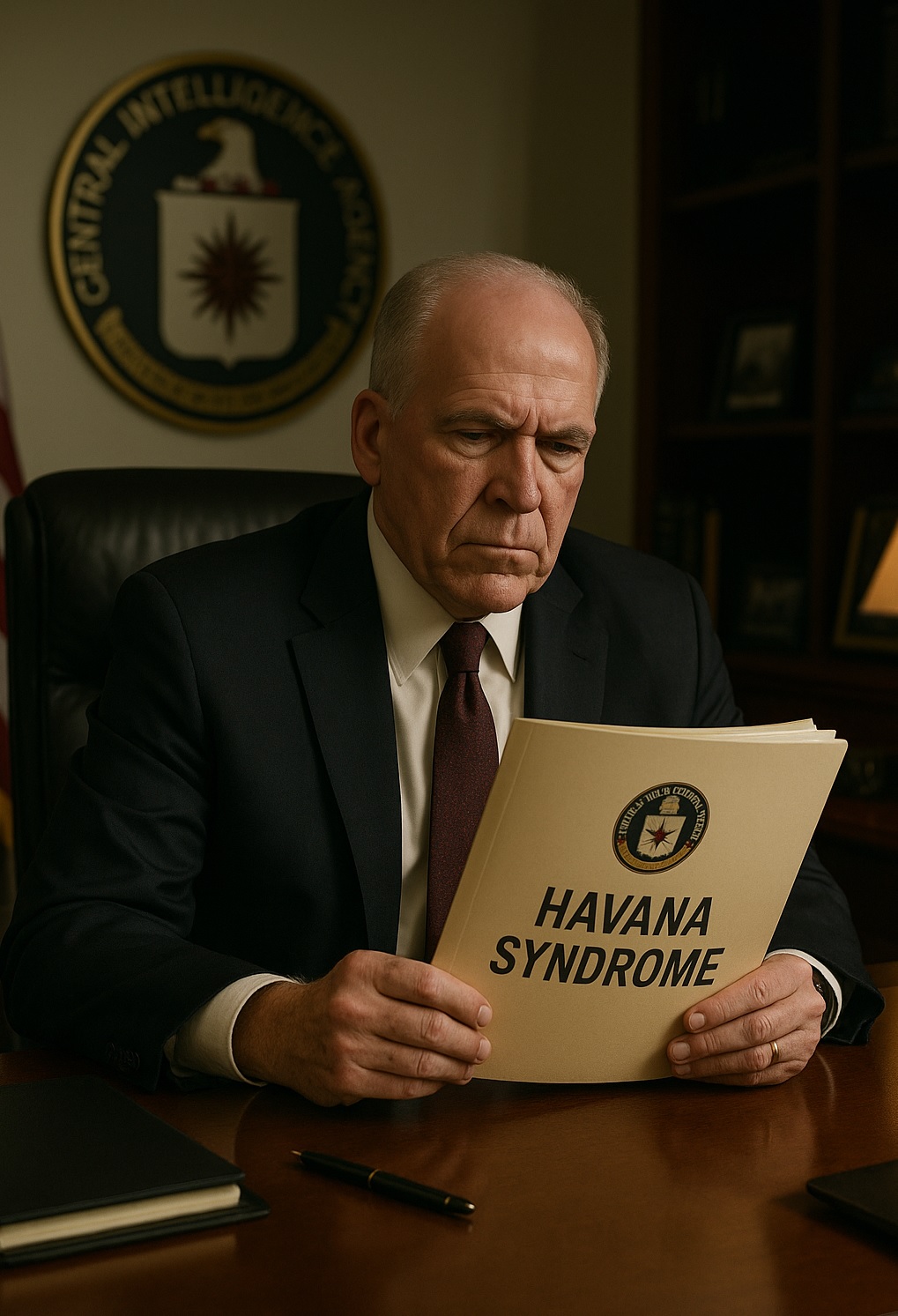
P.S. If John Brennan played a central role in orchestrating the Russia Hoax, it stands to reason he also had a hand in promoting the Havana Syndrome conspiracy theory.
Timeline is everything. Havana Syndrome allegations began shortly after the 2016 election and effectively ended with Trump’s presidency.
This mysterious illness narrative conveniently served as another tool to undermine and discredit the Trump administration, continuing a pattern of using questionable intelligence to fuel political agendas.
END of UPDATE
“John Brennan should be facing a grand jury.”
Senator Rand Paul
UPDATE (July 9, 2025) — In a stunning development, the FBI has officially launched a criminal investigation into former CIA Director John Brennan, following a referral from current Director John Ratcliffe.
This marks a significant escalation in the ongoing scrutiny surrounding the 2016 Intelligence Community Assessment (ICA) and the broader Russiagate saga.
The investigation centers on Brennan’s alleged role in the ICA, focusing on potential false statements made to Congress and accusations of intelligence manipulation tied to the Trump-Russia narrative.
Former FBI Director James Comey is also reportedly in the crosshairs, as investigators examine the broader intelligence and investigative actions taken during that turbulent period.
–
This probe could reshape the public’s understanding of the politicization within U.S. intelligence agencies, shedding new light on actions taken during the Obama administration and the early days of the Trump presidency.
RELATED POST : 1975: The Year of Intelligence [What the Church and Pike Investigations Revealed — and Why Their Warnings Still Matter]
As this story unfolds, it underscores the lasting impact of intelligence on U.S. political dynamics and national security. On the 50th anniversary of the Year of Intelligence, it seems we’re heading for a remake.
END of UPDATE
“Either we need a new election or hang former CIA Director John Brennan for putting out disinformation.”
Robert Baer
Former CIA operative
Newsweek (January 2017)
When politics and intelligence mix, the truth becomes a battlefield. Brennan’s influence over the Russiagate narrative, particularly his push to include unverified elements such as the Steele dossier, has long drawn criticism.
The new review brings fresh clarity to just how deeply his actions may have distorted intelligence processes during a pivotal period. But one question remains: Did Brennan promote the Havana Syndrome hoax?
“The core of this conspiracy began with John Brennan and ends with John Brennan. This is very serious business and for the first time, I now believe that some of these guys [James Comey, John Brennan and James Clapper] are going to go to prison. (…) Brennan needs five lawyers.”
Joe diGenova
Former U.S. Attorney and Special Counsel
(May 15 2019)
CIA Tradecraft Review of the 2016 Election
In early 2025, CIA Director John Ratcliffe ordered a comprehensive, lessons-learned review of the analytic tradecraft behind the Intelligence Community Assessment (ICA) issued shortly after the 2016 election. This week, the findings were declassified.
The review uncovered several procedural anomalies in the preparation of the ICA:
— A compressed timeline that undermined deliberative analysis
— Uneven access to compartmented intelligence
— Marginalization of the National Intelligence Council
— And unusual direct involvement of agency heads, including Brennan
The findings emphasize that adherence to tradecraft standards is critical to maintaining the credibility and objectivity of CIA assessments—both of which were seriously compromised.
Brennan’s Broader Role
In the shadow world of espionage, facts are currency — but sometimes the currency is counterfeit. Beyond Russiagate, Brennan also inserted himself into other politically sensitive narratives.
His endorsement of the claim that the Hunter Biden laptop was a Russian disinformation operation — later disproven—further exemplifies a pattern of politicized intelligence messaging.
Brennan had both the means and the motive to shape intelligence narratives in ways that could discredit political opponents, protect favored interests, and reinforce his influence.
Havana Syndrome in the Brennan Context
Enter Havana Syndrome — the unexplained neurological symptoms first reported by U.S. diplomats in Cuba shortly after Trump’s 2016 victory.
Suspicion originally stemmed from a CIA officer stationed in Havana, and the phenomenon escalated rapidly before fading almost entirely after the 2020 election.
This timeline is more than suspicious as it hints at a possible intelligence operation, not just a medical mystery.
The notion that Brennan’s network used Havana Syndrome as a psychological and political tool fits the “truth seeding” strategy long taught within intelligence circles: blending real-world anomalies with exaggeration to create a persuasive but misleading narrative. The effect? Greater funding, increased public alarm, and sustained political pressure.
“The greatest enemy of knowledge is not ignorance, it is the illusion of knowledge.”
Stephen Hawking
The Wider Network
Figures such as attorney Mark Zaid and ex-CIA officer Michael Polymeropoulos appear at key junctions in both the Havana Syndrome and Hunter Biden narratives — suggesting coordination rather than coincidence.
Their roles in both shaping public perception and driving institutional action underscore a deeper entanglement between legal, media, and intelligence networks.
The problem with the truth is not that it is difficult to know, but that it is difficult to accept.
Conclusion
On the balance of evidence, it is far more plausible that Havana Syndrome reflects internal dysfunction and politicization within the CIA than the mythical powers of a Russian microwave death ray.
This case illustrates how intelligence agencies can weaponize narratives — blurring the lines between fact and fabrication.
RELATED POST : Fake News, Real Questions
In an era where trust in institutions is fragile, we must view official intelligence claims with critical scrutiny and demand accountability from those sworn to serve truth over politics.
RELATED POST : On This Day — President Truman Creates the Central Intelligence Group (January 22, 1946) [Gallup Poll : Americans’ rating of the CIA]
In January 2017, former CIA operative Robert Baer warned, “We need a new election or hang former CIA Director John Brennan for putting out disinformation.”
Well, we got the new election — and we know how that turned out.
But if IntelToday is right, and Havana Syndrome was in fact a CIA-driven hoax—seeded, politicized, and weaponized—then serious accountability must follow.
Brennan’s legacy won’t be salvaged by classified memos or cable news panels. It will be judged by history, and possibly by law.
Disinformation at the highest levels of the intelligence community is not just a scandal. It’s a threat to democracy.
REFERENCES
CIA Director John Ratcliffe Declassifies Internal Tradecraft Review of 2016 Election ICA to Promote Analytic Objectivity and Transparency — CIA website (July 2, 2025)
=
Revisiting Havana Syndrome: Moscow Death Ray vs. CIA Hoax [New Revelations on John Brennan & Russiagate]
 Intel Today