
“The siren howled. But I just sat there for a few seconds, staring at the big, back-lit, red screen with the word ‘LAUNCH’ on it.”
Colonel Stanislav Petrov
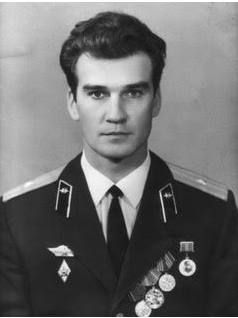
September 26 2025 — On September 26 1983 — just three weeks after the Soviet military had shot down Korean Air Lines Flight 007 — Stanislav Petrov was the duty officer at the command center for the Oko nuclear early-warning system when the system reported that a missile had been launched from the United States, followed by up to five more.
Petrov judged the reports to be a false alarm and his decision is credited with having prevented an erroneous retaliatory nuclear attack on the United States and its NATO allies that could have resulted in large-scale nuclear war. Investigation later confirmed that the Soviet satellite warning system had indeed malfunctioned. Follow us on Twitter: @INTEL_TODAY
RELATED POST: Suspicious Aviation Tragedies: Korean Airliner Flight 007
RELATED POST: Significant Uncertainties in the Yield Estimate of North Korea H Bomb
RELATED POST: The VELA Incident: Declassified Files Shed Light on the Nuclear Test Controversy
RELATED POST: One Year Ago — Top US Nuclear Commander: “I wouldn’t carry out illegal nuclear strike order from Trump”
RELATED POST: One Year Ago — Former Double Agent : “Self-destruction of humankind has been put back on the agenda”
“Expanding NATO would be the most fateful error of American policy in the post cold-war era. Such a decision may be expected . . . to impel Russian foreign policy in directions decidedly not to our liking.”
A Fateful Error
Diplomat-historian George F. Kennan
(Feb. 5, 1997)
UPDATE (Sept. 26, 2025) — The story of Stanislav Petrov remains highly relevant today. Despite the increasing reliance on AI and automated technologies, Petrov’s experience shows that human judgment is crucial in critical situations.
While systems have evolved, the potential for malfunctions or false alarms still exists, and a human’s capacity to make rational, calm decisions can be the deciding factor between peace and catastrophe.
However, to allow time for reflection, it is imperative to avoid situations where there is no time for thoughtful decision-making. During the Cold War, it was often necessary to make decisions based on realpolitik.
In the aftermath of WWII, the Soviet Union expanded its influence over Eastern Europe, while the U.S. concentrated on keeping Western Europe within its capitalist sphere.
Despite strong Communist movements in both France and Italy, the U.S. ensured these countries remained aligned with the West by effectively “trading” them for Hungary, Bulgaria, Poland, and Romania, which fell under Soviet influence. The end result created a buffer zone between the Soviet Union and the West.
During the Cuban Missile Crisis, the U.S. and the Soviet Union effectively “traded” Cuba for Turkey, with the Russians agreeing to keep the deal secret at Kennedy’s request.
In those days, diplomacy was conducted by highly capable intellectuals such as American diplomat George Kennan, Soviet Foreign Minister Vyacheslav Molotov, and Chinese Premier Zhou Enlai. It is clear that giants truly roamed the earth back then.
Not surprisingly, Ambassador Kennan was absolutely opposed to the extension of NATO and the Americanization of Ukraine, let alone a CIA coup. Today, we see what happens when decision-makers do not listen to experts.
END of UPDATE
“September 26 — Stanislav Petrov Day — is as good a time as any to remember that as long as the US and Russia retain massive nuclear arsenals, these kinds of close calls will remain possible — and in the future, a false alarm could result in an accidental first strike.”
On September 26 1983, false alarm at a Soviet command center nearly led to nuclear war.
Stanislav Petrov , a lieutenant colonel in the Soviet Air Defence Forces, was in charge at a secret bunker near Moscow when an alarm sounded, indicating that the US had launched a nuclear missile.
“The incident took place at a particularly tense time during the Cold War, as the USSR had shot down a South Korean passenger jet in Soviet airspace just three weeks before.
If the US launched a nuclear attack, the Russians almost certainly would have retaliated with a devastating counterattack.
Fortunately, Petrov showed poise and restraint.
He had a hunch the warning was a false alarm, and he held to that view even when the computer system reported the launch of four more Minuteman intercontinental ballistic missiles.
Petrov later said the main reason for his conclusion was that the US would have launched a nuclear attack with a barrage of missiles, not five, to cripple the USSR.
He also doubted the satellite-based early-warning technology; the more reliable ground-based radar, which would have picked up the incoming missiles minutes later, showed nothing out of the ordinary.” [Physics Today]
On this day in 1983, Colonel Petrov simply saved the world.
He was not even supposed to be on duty. He was replacing a sick colleague. Many of his colleagues — probably all of them — would have most likely followed the procedure.
Petrov died on May 19 2017 at the age of 77.
“My fellow Americans, I am pleased to tell you today that I’ve signed legislation that will outlaw Russia forever. We begin bombing in five minutes.”
President Ronald Reagan (August 11, 1984)
What if?
On August 1 1984, President Ronald Reagan joked about nuking Russia during a sound check for his Saturday radio address.
Reporters and technicians in the room laughed at the joke. Then the tape was leaked. And the Russians were not amused… The Pentagon confirmed that Soviets were actually, and understandably, on war alert.
Embarrassed U.S. officials quickly assured the Kremlin that Reagan’s offhand remark did not reflect White House policies or U.S. military intentions.
What if? Ask yourself a simple question. What if Reagan had told his great joke a year earlier and the tape had been leaked a few days before September 26 1983?
“Petrov had to make a decision: Would he report an incoming American strike? If he did, Soviet nuclear doctrine called for a full nuclear retaliation. There would be no time to double-check the warning system, much less seek negotiations with the US.” [A nuclear conflict with Russia is likelier than you think — Max Fisher]
Obviously, Colonel Stanislav Petrov may have reached a very different conclusion…
END of UPDATE
“The Man Who Saved The World”
REFERENCES
Nuclear false alarm — Physics Today
=
On This Day — Stanislav Petrov Saves the World from Nuclear War (Sept. 26 1983)
 Intel Today