
“Today we pay tribute to fallen officer Robert W. Brown Jr., who died in the line of duty in February 1968. Although his sacrifice has long been honored as a star on the wall, his name was only made public during this year’s annual Memorial Ceremony on June 6 [2025].”
Central Intelligence Agency
(June 24, 2025)
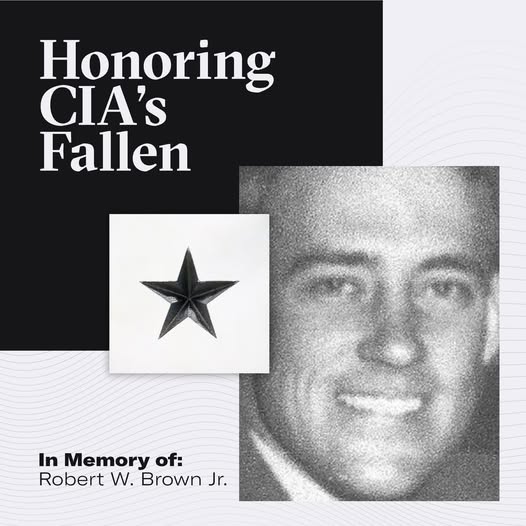
June 25, 2025 — In a recent post about the CIA Memorial Wall, I pointed out that the numbers quoted by the CIA director don’t add up. Getting the math right might seem like a small detail — but when it comes to honoring fallen officers, precision, like truth, matters. Unfortunately, the CIA’s latest release isn’t an improvement. According to the agency, U.S. Marine Captain Robert “Bob” Wilson Brown’s sacrifice has long been honored with a star on the wall. That is simply not true. Follow us on Twitter: @INTEL_TODAY
RELATED POST : CIA 2025 Annual Ceremony — CIA Numbers Don’t Add Up… Again!
RELATED POST : The CIA Memorial Wall and AI: Why ChatGPT Users Are Visiting IntelToday
RELATED POST : Intel Today Book on CIA Memorial Wall Banned by Amazon
RELATED POST : CIA Memorial Wall — STAR 0 : Jane Wallis Burrell (Paris, France – January 6, 1948) [CIA’s Modern Censorship Battles]
RELATED POST : CIA Memorial Wall — STAR 1 : Douglas S. Mackiernan (Tibet – April 29, 1950)
RELATED POST : CIA Memorial Wall — STAR 2 : Jerome P. Ginley (East China Sea – January 11, 1951)
RELATED POST : CIA Memorial Wall — STAR 3 : Wilburn S. Rose (Groom Lake, Nevada – May 15, 1956)
RELATED POST : CIA Memorial Wall — STAR 4 : William Pierce Boteler (Cyprus – June 16, 1956)
RELATED POST : Honoring CIA’s Fallen : Robert W. Hubbard (Vietnam — February 4, 1968)
Robert W. Brown was detailed to the CIA on April 10, 1967 to participate in the Revolutionary Development Cadre.
According to the CIA, “the program brought experienced U.S. military officers on to serve as advisers and help win the hearts and minds of the Vietnamese by providing armed protection and reconstruction projects for rural villages.”
On February 26, 1968, he was leading a mission to resupply the Truong Son provincial cadre team and inspect the area in Darlac Province when he was targeted by small arms fire.
“The Phoenix program was a very, very clearly defined and effective effort to target and destroy the Viet Cong political infrastructure. It was essentially a large-scale assassination program.”
CIA officer Ralph McGehee
Book of Honor
According to the CIA, Robert W. Brown’s sacrifice has long been honored with a star on the wall. This is certainly not true.
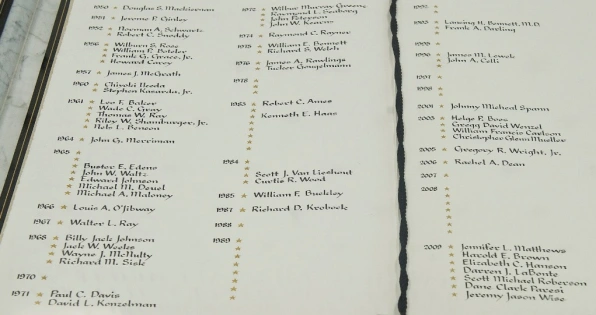
In 2010 — forty two years after his death — there was no star honoring either U.S. Marine Captain Robert Wilson Brown Jr. or U.S. Marine Captain Robert Walker Hubbard.
And so, we are left with three questions:
1) Why was Robert W. Brown, just like Robert W. Hubbard, not included among the first 31 stars on the wall?
2) In what year was his sacrifice finally honored with a star?
3) And why is the CIA misrepresenting this simple fact?
Long and complex history of connections between USAID and the CIA
In a piece published by Slate earlier this year (Why It’s a Huge Deal That Trump Is Trying to Shut Down USAID), Fred Kaplan outlines the opaque relationship between the two agencies:
“During the Cold War, they worked together in training police forces all across the world, notably in Latin America, where the exercises allegedly included techniques of torture.USAID also served as cover for various covert activities, especially during the Vietnam War. After the Cold War, according to Weiner, the agency funded democracy-building programs in the former Soviet Union, ‘sometimes on its own, sometimes in concert with the CIA.’ As recently as 10 years ago, it used its pro-democracy rubric to help foment anti-regime propaganda in Cuba. Throughout this period, as was the case with U.S. embassies generally, USAID was used as a front for CIA officers, though, Weiner says, ‘much less frequently now’ than in the old days.”
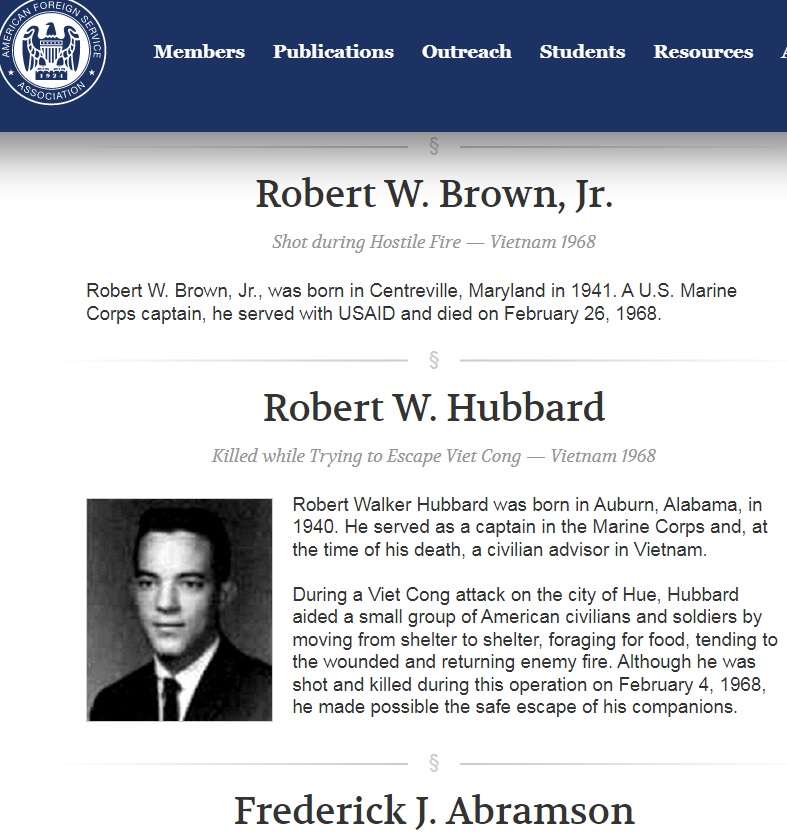
What is beyond dispute is that CIA officer Robert W. Brown Jr. was operating under USAID cover when he died on February 26, 1968.
This fact alone may help explain why the CIA chose not to include his name among the first 31 stars commemorated on its Memorial Wall.
“The Phoenix program was a murderous operation, designed to eliminate the civilian support structure of the Viet Cong, through assassination, torture, and terror.”
Noam Chomsky
The Revolutionary Development Cadre: A Veil for the Phoenix Program
Both Robert W. Brown Jr. and fellow CIA officer Douglas S. Hubbard were assigned to the Revolutionary Development Cadre (RDC) at the time of their deaths in Vietnam. Ostensibly, the RDC was a civic action initiative, aimed at promoting rural development, extending South Vietnamese government control, and undermining Viet Cong influence in contested areas. However, a closer look reveals that the RDC may have served as more than just a vehicle for aid and nation-building.
The RDC operated as a key element of early U.S. and South Vietnamese “pacification” efforts — programs that increasingly blurred the lines between civil development and covert counterinsurgency. With U.S. support, RDC teams combined psychological operations, civic outreach, and intelligence gathering under the guise of development work. American advisors embedded in these teams often had dual roles: engaging in public diplomacy while feeding intelligence into broader U.S. strategic objectives.
By 1967, these operations became formalized under the Phoenix Program — a controversial CIA-led initiative designed to “neutralize” the Viet Cong Infrastructure (VCI) through capture, interrogation, or assassination. While the RDC was never officially labeled part of Phoenix, it shared personnel, intelligence networks, and operational goals. In practice, it often functioned as a covert extension of the Phoenix Program, especially in rural provinces where American officers like Brown and Hubbard were stationed.
In this context, Brown’s role within the Revolutionary Development Cadre takes on a more complex and shadowed dimension. His presence in Vietnam under USAID cover—and in a program closely tied to covert counterinsurgency — raises pressing questions about the clandestine nature of U.S. operations during the war.
Even more telling is the fact that both Brown and Hubbard were omitted from the CIA’s Memorial Wall for nearly half a century. Their delayed recognition may reflect the ambiguity — and deniability — that surrounded their assignments. It also underscores a broader pattern: when covert operatives work under official covers like USAID or pacification programs, their service — and even their sacrifice — can remain classified, unacknowledged, or politically inconvenient for decades.
REFERENCES
Heroes : Robert W. Brown — CIA website
=
Honoring CIA’s Fallen : Robert W. Brown Jr. (Vietnam — February 26, 1968)
 Intel Today