
“Prior to launching strikes on Iran, Israel shared intelligence with the United States… However, U.S. intelligence officials were unconvinced, seeing it instead as a continuation of research halted since 2003.”
Wall Street Journal
June 18, 2025
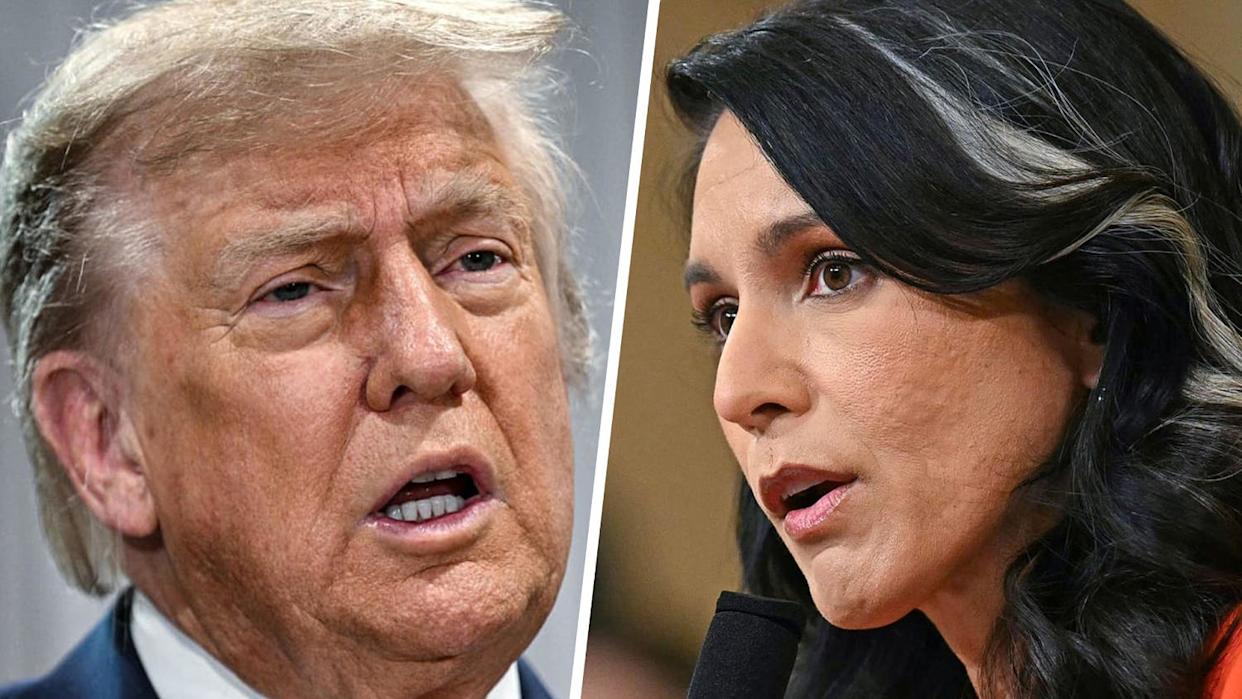
June 18, 2025 — Former President Donald Trump made no secret of his deep distrust for the CIA and the broader U.S. intelligence establishment. Throughout his first term, he clashed with officials over everything from Russian election interference to the supposed threat of Iran. So, when Trump nominated former Congresswoman Tulsi Gabbard as Director of National Intelligence, the move shocked many—but also made a certain kind of sense. Follow us on Twitter: @INTEL_TODAY
RELATED POST : One Year Ago — Secretary of State Mike Pompeo : “US Government Determined to Change the Behavior of Ayatollah Khomeini”
Gabbard, an Iraq War veteran and long-time critic of U.S. regime-change wars, has consistently questioned the motives and credibility of America’s foreign interventions. At a recent congressional hearing, she offered a calm but damning assessment:
“The intelligence community continues to assess that Iran is not building a nuclear weapon and supreme leader Khomeini [sic] has not authorized the nuclear weapons program that he suspended in 2003.”
But now, Trump just dismissed her testimony with his trademark bluntness:
“I don’t care what she said. I think they were very close to having one.”
Trump’s preference for the word of Israeli Prime Minister Benjamin Netanyahu over the conclusions of 18 U.S. intelligence agencies is not new — but it laid bare the deep dysfunction between the Oval Office and the sprawling $100 billion intelligence complex.
The Eisenhower Warning
Back in 1961, President Dwight D. Eisenhower issued a now-famous warning in his farewell address: the United States had become vulnerable to a “military-industrial complex,” where immense power and influence were accumulating within defense contractors, military leadership, and intelligence agencies — well beyond what a healthy democracy could tolerate.
Eisenhower, a five-star general, understood the necessity of intelligence. But he also believed espionage was a dangerous tool to be used sparingly. He reluctantly approved U-2 spy plane missions over the Soviet Union, knowing they violated international law, but believing they were needed to expose the myth of a “missile gap” used by the Pentagon to inflate its budget.
His aim was always national defense, not empire-building. And his priority was clear: keep military and intelligence spending as low as possible while preserving American security and quality of life. Six decades later, that vision lies in ruins.
The $100 Billion Question
In 2023, the U.S. intelligence community spent $67.1 billion through the National Intelligence Program and $26.6 billion through the Military Intelligence Program—a staggering $93.7 billion in total.
And yet, for all that money, the public remains deeply skeptical of the intelligence community’s credibility.
Major policy decisions are still driven by foreign influence, private interests, or presidential hunches. National security crises — whether real or manufactured — continue to emerge unchecked.
If the goal of intelligence spending is to inform leadership, reduce threats, and strengthen democracy, then what exactly are we getting for our $100 billion a year?
More surveillance. More secrecy. Less accountability.
And a president who prefers personal loyalty and foreign leaders over facts.
Conclusion
The United States intelligence budget has ballooned into one of the most expensive and least questioned parts of the federal government.
But the results — wars based on bad information, erosion of civil liberties, and a political class that routinely ignores the analysis it’s handed — raise a deeper question:
Are the American people funding national security — or just an elaborate illusion?
REFERENCES
Trump brushes off US intel reports on Iran to align himself with Israel — The Guardian, Andrew Roth
=
False Flags and Fat Budgets: America’s Intelligence Illusion [The Intelligence Trap: Trump, DNI Tulsi, and the $100 Billion Question]
“In the councils of government, we must guard against the acquisition of unwarranted influence… by the military-industrial complex.”
President Dwight D. Eisenhower, 1961
 Intel Today