
“Crowding, rapid change and the breakdown of communities have been widely recognized as sources of social problems. But we do not believe they are enough to account for the extent of the problems that are seen today.
If the system breaks down the consequences will still be very painful. But the bigger the system grows the more disastrous the results of its breakdown will be, so if it is to break down it had best break down sooner rather than later.
The concept of ‘mental health’ in our society is defined largely by the extent to which an individual behaves in accord with the needs of the system and does so without showing signs of stress.”
Theodore John Kaczynski
aka
The Unabomber

April 3 2022 — On April 3 1996, FBI agents raided the Montana cabin of Ted Kaczynski, also known as the Unabomber. In his essays, the Unabomber wrote about ethics and technology. The current pandemic raises many such issues. Is it ‘right’ to impose a vaccine if you know that it will save millions while killing a few? Let me ask you a hypothetical question… The trolley problem is a thought experiment in ethics modeling an ethical dilemma. It is generally considered to represent a classic clash between two schools of moral thought, utilitarianism and deontological ethics. Follow us on Twitter: @INTEL_TODAY
RELATED POST: Coronavirus — “Potential Emergence of a Global Pandemic” [NIC — Global Trends 2025 (November 2008)]
RELATED POST : On This Day — Italian Physicist Ettore Majorana vanishes (March 25, 1938) [What Elon Musk does not know…]
“Be careful of scientists! They start by inventing the machine to make butter, and they end up inventing the atomic bomb.”
Marcel Pagnol
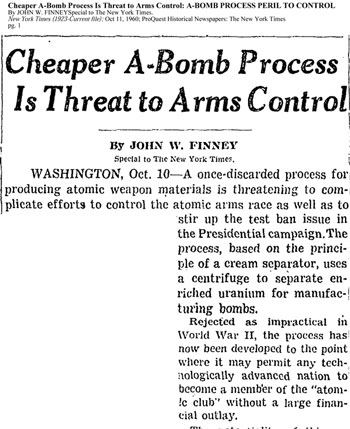
UPDATE (April 3 2025) — Marcel Pagnol, a French writer, playwright, and filmmaker, was known for his critical and sometimes ironic view of scientific and technological progress. This phrase aptly reflects his concerns about the unforeseen consequences of scientific advances.
Pagnol may not have realized it, but his comment is scientifically accurate. The principle behind a uranium enrichment centrifuge—allowing the centrifuge to balance itself—is directly rooted in the design of the cream separator (or butter centrifuge), which was developed in the late 19th century.
In both cases, centrifugal force is used to separate substances based on their mass. Butter/Cream Centrifuges separate cream from milk by exploiting the slight density difference. Uranium Centrifuges separate uranium isotopes (U-235 from U-238) based on their tiny mass difference.
The self-balancing mechanism, which is crucial for stable, long-term operation at high speeds, was originally developed for dairy centrifuges before being adapted for nuclear technology. In a way, Pagnol’s ironic remark turned out to be a deep truth about scientific progress.
Pagnol’s remark touches on a broader reality: many scientists have faced deep regret over how their discoveries were used. In addition to Robert Oppenheimer (nuclear bomb), Arthur Galston (Agent Orange), Mikhail Kalashnikov (AK-47), and Alfred Nobel (dynamite), the list includes Kary Mullis (PCR – Polymerase Chain Reaction), Fritz Haber (Synthetic Ammonia & Chemical Warfare), and even Tim Berners-Lee (World Wide Web).
Mullis was proud of his Nobel-winning invention, but he later regretted its misuse, particularly in forensic science and medical testing, where he felt it was often misapplied or overstated.
While his discovery of the Haber-Bosch process helped feed the world, his work on chemical warfare in World War I (chlorine gas) led to mass suffering. His wife, Clara Immerwahr, opposed his work and tragically took her own life in protest.
Although he remains proud of the internet, Berners-Lee has expressed disappointment over how it has been used for misinformation, privacy invasion, and cybercrime. He has been working on projects to “fix” the internet, such as Solid (a decentralized data system)
This concern is not just historical. Twenty-five years ago, I worked on the construction of the KamLAND neutrino detector in Japan, and one of the first things I did was estimate its potential impact on detecting nuclear submarines. If neutrino-based technology ever makes the oceans “transparent,” allowing a superpower to track and target these submarines, it could destabilize global security. The temptation to eliminate second-strike capabilities could push a nation toward attempting to win a nuclear war—a scenario that could have catastrophic consequences for humanity.
I think about this every day. Scientific breakthroughs often have unintended consequences, and history has shown how even well-intended discoveries can be repurposed in ways that threaten global stability.
Many scientists—Oppenheimer, Sakharov, and others—have struggled with the moral weight of their work. The dual-use nature of technology is a challenge we cannot ignore, and if this threat ever becomes imminent, those who understand it must be the ones to sound the alarm.
Final Thought/Question for Readers:
On April 3, 1996, FBI agents raided the Montana cabin of Ted Kaczynski, also known as the Unabomber. In his essays, the Unabomber explored the ethics of technology and its potential to harm society.
Let us consider a hypothetical scenario: a scientist is developing a virus that poses a significant threat to millions of lives. You find yourself with a unique opportunity to prevent this catastrophe by eliminating the scientist. What would you do?
This dilemma—whether to sacrifice one individual for the greater good or to protect life even when it might enable harm—raises fundamental questions about the value of human life, the limits of science, and the role of moral judgment in a world shaped by technological power.
This question challenges readers to reflect on their own values, asking them to consider:
Is there ever a justification for preemptive action in the name of safety?
What responsibility does the scientist have in considering the potential consequences of their work?
Can technology, once developed, be safely controlled, or does it inevitably lead to destruction?
Where should we draw the line between moral action and the rule of law, or between the individual and the collective good?
The ethical choices of today’s scientists and the consequences of their discoveries are often overlooked, perhaps because few truly understand the complexities of science and its potential consequences in our increasingly fragile civilization.
Ettore Majorana understood all this better than anyone. And he chose to vanish…
END of UPDATE
“I believe that human freedom and the natural environment are fundamentally incompatible.”
Theodore Kaczynski
UPDATE (April 3, 2024) — A modern version of the Trolley experiment (Covid-19)
Theodore Kaczynski, better known as the UNABOMBER, was a mathematics prodigy who abandoned his academic career in 1969 to pursue a primitive lifestyle.
RELATED POST : On This Day — Italian Physicist Ettore Majorana vanishes (March 25, 1938)
However, between 1978 and 1995, Kaczynski carried out a series of bombings that resulted in three fatalities and 23 injuries in a nationwide mail bombing campaign.
He targeted individuals whom he believed were advancing modern technology at the expense of the natural environment. While Kaczynski’s critiques of technology resonate with some, his methods are widely condemned.
Moving forward to the present, the COVID-19 pandemic has brought into focus the complex interplay between technology, society, and ethics.
New estimates from the World Health Organization (WHO) suggest that the pandemic’s full death toll, including indirect impacts, may have exceeded 14.9 million between January 2020 and December 2021.
In light of these challenges, let us consider a hypothetical scenario: a scientist is developing a virus that poses a significant threat to millions of lives. You find yourself faced with a unique opportunity to prevent this catastrophe by eliminating the scientist.
What would you do?
This thought experiment prompts us to confront ethical dilemmas surrounding the use of preemptive violence to prevent harm and the complex moral calculations involved in such decisions.
END of UPDATE
“We are going to argue that industrial-technological society cannot be reformed in such a way as to prevent it from progressively narrowing the sphere of human freedom.”
Ted Kaczynski
The general form of the problem is this. There is a runaway trolley barreling down the railway tracks. Ahead, on the tracks, there are five people tied up and unable to move.
The trolley is headed straight for them. You are standing some distance off in the train yard, next to a lever.
If you pull this lever, the trolley will switch to a different set of tracks. However, you notice that there is one person on the side track.
You have two options:
A — Do nothing and allow the trolley to kill the five people on the main track.
B — Pull the lever, diverting the trolley onto the side track where it will kill one person.
Which is the more ethical option? Or, more simply: What is the right thing to do?
Intel Today would like to know what you think?
– – –
The Trolley Problem Explained
In 1967 Philippa Foot introduced us to the thought experiment called the Trolley Problem. This problem introduces a situation where a runaway trolley carrying four people is careening down the tracks towards a dead end.
The four people in the trolley will certainly be killed if nothing is done. There is an option to divert the runaway trolley and save the four people but in doing so you will kill one person that is in the path of the now diverted trolley. What do you do?
In this clip a robot is introduced in to the equation. Can humans code A.I. that would make the right choice.?
REFERENCES
Trolley problem — Wikipedia
=
On This Day — FBI agents arrest Ted Kaczynski (April 3 1996) [Ethics & The Trolley Thought Experiment]
On This Day — FBI agents arrest Ted Kaczynski (April 3 1996) [UPDATE : A modern version of the Trolley experiment (Covid-19)]
 Intel Today