
“It is now very clear that there were two separate agreements, one the official agreement with Carter in Algeria, the other, a secret agreement with another party, which, it is now apparent, was Reagan. They made a deal with Reagan that the hostages should not be released until after Reagan became president. So, then in return, Reagan would give them arms. We have published documents which show that US arms were shipped, via Israel, in March, about 2 months after Reagan became president.”
Former Iranian President Abolhassan Banisadr
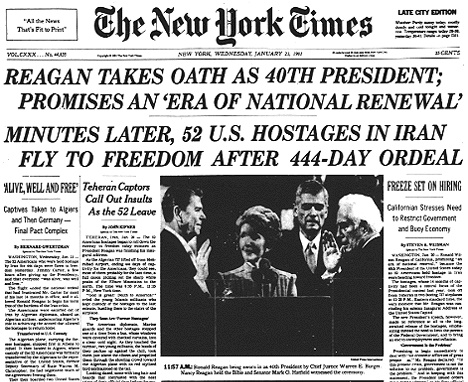
January 20 2025 — On January 20 1981, 20 minutes after Reagan concluded his inaugural address, the Islamic Republic of Iran announced the release of 52 Americans being held hostage in Iran since November 4 1979. Allegations that the Reagan administration negotiated a delay in the release of the hostages until after the 1980 presidential election have been numerous. Gary Sick, principal White House aide for Iran and the Persian Gulf on the Carter administration’s National Security Council, claimed in his book “October Surprise: America’s Hostages in Iran and the Election of Ronald Reagan” that CIA Director William Casey and possibly Vice President George H. W. Bush went to Paris to negotiate such a delay. Follow us on Twitter: @INTEL_TODAY
RELATED POST: On This Day — Reagan Approves Covert Arms Sales to Iran (January 17, 1986)
RELATED POST: On This Day — Decadence and Downfall: The Shah of Iran’s Ultimate Party (Oct. 12-16 1971)
RELATED POST: On This Day — 1953 Iranian Coup d’État [August 19 – CIA Op TP/AJAX]
RELATED POST: Meet Trump’s new Iran Man: CIA Michael D’Andrea
RELATED POST: Former Iranian President Akbar Hashemi Rafsanjani Takes Many Secrets to His Grave
“Unger has pursued the story of the October surprise for more than 30 years, often to his own cost. …peppered with amazing details… Den of Spies comes out in a world where dark machinations to win power no longer seem so unthinkable as in the days of Carter, Reagan and Bush.”
The Guardian
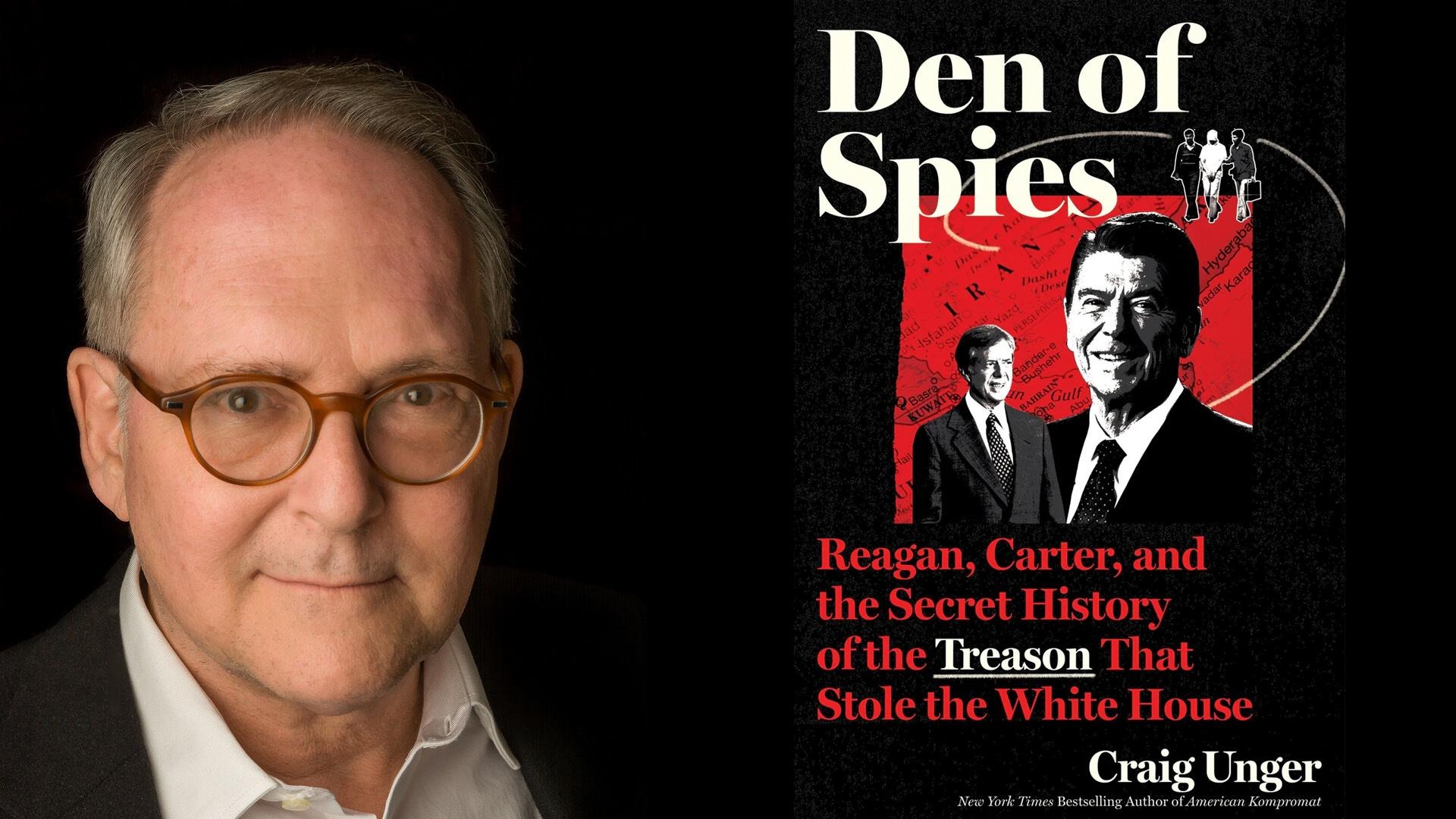
UPDATE (January 20 2025) — Recent revelations from Ben Barnes, a former Texas politician, lend credence to the “October Surprise” theory, which posits that the Reagan campaign engaged in clandestine efforts to postpone the hostages’ release, thereby undermining President Jimmy Carter’s re-election bid.
RELATED POST: Did the CIA Betray President Jimmy Carter ?
In March 2023, Barnes disclosed that during the 1980 presidential campaign, he accompanied former Texas Governor John Connally on a tour of several Middle Eastern countries. During this trip, Connally allegedly urged regional leaders to convey to Iran that delaying the release of American hostages until after the U.S. election would be advantageous, suggesting that Iran would receive a better deal under a Reagan administration. Upon returning to the United States, Connally reportedly briefed William J. Casey, Reagan’s campaign manager and later CIA director, about their discussions.
In his latest book, Den of Spies: Reagan, Carter, and the Secret History of the Treason That Stole the White House, Craig Unger revisits the “October Surprise” theory. Unger asserts that Ronald Reagan’s campaign, led by William Casey, engaged in clandestine meetings with Iranian officials to delay the release of the American hostages, thereby undermining President Carter’s re-election efforts. Unger also highlights the roles of key individuals such as William Casey and George H.W. Bush, alleging their involvement in these secret dealings.
If one accepts Craig Unger’s “October Surprise” theory, it could provide a lens through which subsequent events, like the Iran-Contra scandal, are seen not as isolated incidents but as part of a larger, coherent strategy in U.S. foreign and domestic policy. The Iran-Contra scandal revealed a willingness by the Reagan administration to engage in secret, illegal deals with hostile nations (arms-for-hostages), despite its public stances to the contrary. If the “October Surprise” theory is true, it demonstrates that this approach was not anomalous but rather an early example of prioritizing clandestine deals for political and strategic ends.
While critics argue that the theory lacks definitive evidence, it offers a compelling framework for connecting seemingly disparate events into a consistent narrative of power, secrecy, and realpolitik. Particularly in light of recent testimony and corroborative accounts, the “October Surprise” theory deserves serious consideration as a legitimate historical inquiry rather than being dismissed as a conspiracy theory.
Exploring the “October Surprise” theory goes beyond proving or disproving a single event. It’s about understanding how political systems operate, how history is shaped, and how accountability can prevent similar occurrences in the future. The theory underscores the importance of vigilance against oversimplified narratives that might obscure deeper truths.
END of UPDATE
“Ronald Reagan made a deal with the Iranians about the hostages release before he was elected.”
Alan Dershowitz
Harvard Law Professor
(February 2017)
UPDATE (January 20 2024) — This morning, I asked ChatGPT about the current status of this puzzling coincidence. Here is the answer.
The allegations that the Reagan administration negotiated a delay in the release of the hostages until after the 1980 presidential election have been the subject of much debate and controversy. While there is no concrete evidence to definitively prove or disprove these claims, some argue that there were back-channel negotiations between Reagan’s team and Iranian officials.
The Iran hostage crisis, which began on November 4, 1979, had a significant impact on the Carter administration, and the failure to secure the release of the hostages was seen by many as a symbol of American weakness. The timing of the hostage release, just 20 minutes after Ronald Reagan’s inaugural address on January 20, 1981, raised suspicions among some observers.
Proponents of the theory suggest that there may have been a secret deal between the Reagan campaign and Iranian officials to delay the release until after Reagan was sworn in as president, possibly to undermine President Jimmy Carter’s chances of securing a last-minute boost in popularity. However, there is no direct evidence to support these allegations, and some argue that the timing could have been coincidental.
It’s essential to note that investigations into the so-called “October Surprise” allegations have produced mixed results, and no conclusive evidence has been found. Scholars, historians, and political analysts continue to debate the issue, and opinions vary on the validity of the claims. The debate underscores the complexity of international relations and the challenges of uncovering covert diplomatic activities.
I think that the answer is fair and balanced. What do you think? However…
Whenever you learn new facts, you must re-think what you thought you knew. In this case, you may want to reconsider the following events: the release of the hostages on January 20 1981, 20 minutes after Reagan concluded his inaugural address, as well as the Iran-Contra scandal, the 1988 summer massacre and the fall of Ayatollah Montazeri.
I was therefore deeply shocked to read this article titled: Are Republicans and Conservatives More Likely to Believe Conspiracy Theories?
According to the abstract:
“A sizable literature tracing back to Richard Hofstadter’s The Paranoid Style (1964) argues that Republicans and conservatives are more likely to believe conspiracy theories than Democrats and liberals. However, the evidence for this proposition is mixed. Since conspiracy theory beliefs are associated with dangerous orientations and behaviors, it is imperative that social scientists better understand the connection between conspiracy theories and political orientations.”
“First, we examine the relationship between beliefs in 52 conspiracy theories and both partisanship and ideology in the U.S”
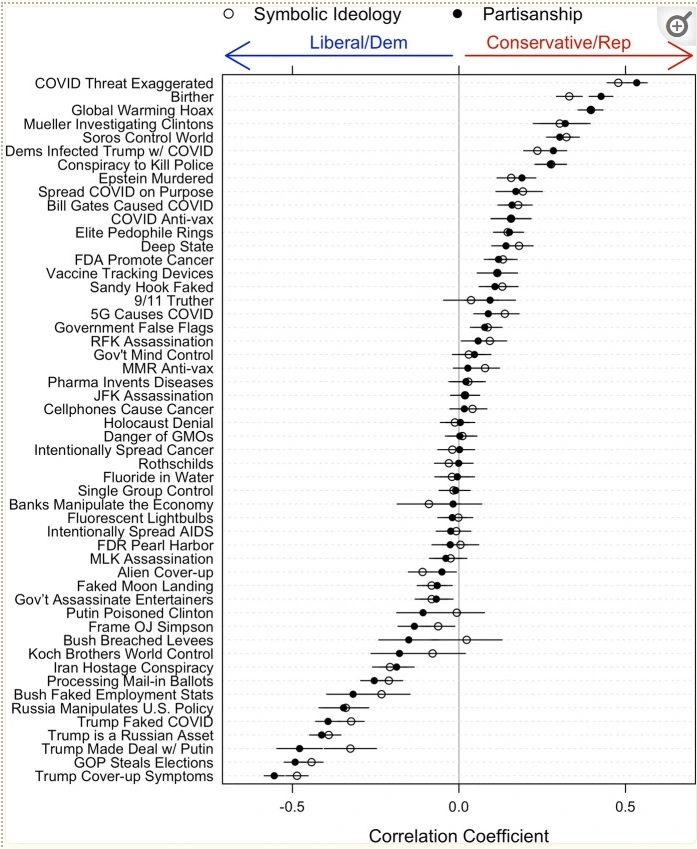
And of course, the story of the hostages is one of the 52 conspiracy theories… Seriously?
Highly respected researchers (including Gary Sick), as well as former Iranian President Abolhassan Banisadr came to the conclusion that Reagan made a deal with the Iranians about the hostages. Fore sure it was never proven, but it is certainly not a crazy theory compared to the parts (including the Iran-Contra scandal) that have been confirmed.
As Professor Stephan Lewandowsky — Chair in Cognitive Psychology at the University of Bristol — wrote:
“This is the long-standing dilemma confronting philosophers. Conspiracies do occur and they can seem quite outlandish and unexpected once publicly revealed.
Who would have thought that Oliver North would sell arms to Iran from the basement of the White House and launder the money to supply arms to Nicaraguan rebels in contravention of explicit legal prohibitions?”
I shall return to this study soon. Stay tuned!
END of UPDATE
“Mr Karrubi agreed in the second Madrid meeting to cooperate with the Reagan campaign about the timing of any hostage release. In return, he was promised that the Reagan Administration, once in office, would return Iran’s frozen assets and help them acquire badly needed military equipment. (…) During my research, I spoke to several of the former hostages. I was deeply moved by the response of one in particular. After listening to the evidence, he said simply: ‘I don’t want to believe it. It’s too painful to think about it.’ Painful it is. But the rest of us are obliged to think about it. Hard.”
Gary Sick — Retired Naval Captain who served on Ford’s, Carter’s, and Reagan’s National Security Council
The timing gave rise to an allegation that representatives of Reagan’s presidential campaign had conspired with Iran to delay the release until after the election to thwart President Carter from pulling off an “October surprise“.
According to the allegation, the Reagan Administration rewarded Iran for its participation in the plot by supplying Iran with weapons via Israel and by unblocking Iranian government monetary assets in US banks.
After twelve years of mixed media attention, both houses of the US Congress held separate inquiries and concluded that the allegations lacked supporting documentation.
Nevertheless, several individuals—most notably former Iranian President Abolhassan Banisadr, former naval intelligence officer and U.S. National Security Council member Gary Sick, and former Reagan/Bush campaign staffer and White House analyst Barbara Honegger—have stood by the allegation.
The US Senate’s 1992 report concluded that “by any standard, the credible evidence now known falls far short of supporting the allegation of an agreement between the Reagan campaign and Iran to delay the release of the hostages.”
The House of Representatives’ 1993 report concluded “there is no credible evidence supporting any attempt by the Reagan presidential campaign—or persons associated with the campaign—to delay the release of the American hostages in Iran”.
Gary Sick was unable to prove his claims, including that, in the days before the presidential election with daily press pools surrounding him and a public travel schedule, vice presidential candidate George H. W. Bush secretly left the country and met with Iranian officials in France to discuss the fate of the hostages.
In 1991, freelance writer Danny Casolaro (among others) claimed to be almost ready to expose the alleged October surprise conspiracy, when he suddenly died a violent death in a hotel bathtub in Martinsburg, WVA, raising suspicions. He appeared to be traveling on leads for his investigation into the Inslaw Affair. His death was ruled a suicide.
RELATED POST : Crypto AG & The Ghost of Danny Casolaro [UPDATE : Family Calling For New Murder Investigation]
While working for Reagan, Barbara Honegger claims to have discovered information that made her believe that George H. W. Bush and William Casey had conspired to assure that Iran would not free the U.S. hostages until Jimmy Carter had been defeated in the 1980 presidential election, and she alleges that arms sales to Iran were a part of that bargain.
In 1987, in the context of the Iran-Contra investigations, Honegger was reported as saying that shortly after 22 October 1980, when Iran abruptly changed the terms of its deal with Carter, a member of the Reagan campaign told her “We don’t have to worry about an October surprise. Dick (referring to Richard V. Allen ) cut a deal.”
The Election Story of the Decade — NYT
Gary Sick wrote an editorial for The New York Times and a book (October Surprise) on the subject.
Sick wrote that in October 1980 officials in Ronald Reagan’s presidential campaign including future CIA Director, William Casey, made a secret deal with Influential Iranian clerics. [I recommend reading this story.]
“Sick’s credibility was boosted by the fact that he was a retired Naval Captain, served on Ford’s, Carter’s, and Reagan’s National Security Council, and held high positions with many prominent organizations; moreover, he had authored a book recently on US-Iran relations (All Fall Down).
Iran would delay the release of the American hostages until after the election and, in return for this, the United States would arrange for Israel to ship weapons to Iran.”
And of course, we know how that one turned out… It is called the “Iran-Contras Scandal”.
Iran Hostage Crisis: Release of 52 Hostages in 1981
(ABC News Report From 1/20/1981)
UPDATE (January 20 2020) — In February 2017, while explaining the ‘Logan Act’ and how it may apply to Michael Flynn’s discussion of sanctions with a Russian ambassador before taking office, Harvard’s Law Professor Alan Dershowitz made an astonishing statement regarding the 1980 US Presidential campaign.
Dershowitz suggested that if the ‘Logan Act’ had been applied in the past, Jimmy Carter and Jesse Jackson would share a jail cell. Then he stated the following:
“Ronald Reagan made a deal with the Iranians about the hostages release before he was elected…”
END of UPDATE
REFERENCES
Iran hostage crisis — Wikipedia
=
On This Day — Tehran Frees US Hostages After 444 Days (January 20 1981)
 Intel Today