
“I voiced to him [U.S. Secretary of War Stimson] my grave misgivings, first on the basis of my belief that Japan was already defeated and that dropping the bomb was completely unnecessary, and secondly because I thought that our country should avoid shocking world opinion by the use of a nuclear weapon.”
General Dwight Eisenhower

August 6 2023 — Seven decades after the US dropped atomic bombs on the Japanese cities of Hiroshima and Nagasaki, the real reasons behind the decision still divide historians. Recently declassified documents from the time suggest the nuclear strikes may have been performed not out of military necessity but to intimidate the USSR. Follow us on Twitter: @INTEL_TODAY
RELATED POST: The Los Alamos Primer — The Bethe – Feynman Equation [Nukes & Secrecy]
RELATED POST: On This Day — Atomic Spies Rosenbergs Executed (June 19 1953)
RELATED POST: Significant Uncertainties in the Yield Estimate of North Korea H Bomb
RELATED POST: A SCIENTIFIC ANALYSIS OF NORTH KOREA SECOND NUCLEAR TEST (May 25 2009)
RELATED POST: One Year Ago — The True Story of Dr A. Q. Khan’s Nuclear Black Market
RELATED POST: Saudis Will Build Nukes If Tehran Does [Flashback]
RELATED POST: Flashback — When Belgium Exported Nuke Tech to Iran
RELATED STORY: The VELA Incident: Declassified Files Shed Light on the Nuclear Test Controversy
RELATED POST: Libyan Nuke Program Was CIA-MI6 Sting Op
“The use of this barbarous weapon at Hiroshima and Nagasaki was of no material assistance in our war against Japan. The Japanese were already defeated and ready to surrender.”
US Admiral William Leahy
In the early 90s, George Wells FARWELL introduced me to Hans BETHE, often described as the most important “gift” from Nazi Germany to the United States.
Bethe came to U.W. in Seattle to discuss first the 1987A supernova and then — what was known at that time as — the solar neutrino puzzle.
After graduating from Harvard in 1941, Farwell began post-graduate studies in physics at Berkeley. In 1943 he joined the Manhattan Project at Los Alamos, New Mexico.
He participated in the first atomic bomb detonation at Trinity Site, New Mexico, in 1945.
After the war he completed his PhD under Enrico Fermi at the University of Chicago. The subject was the induced fission of Plutonium.
Once George told me about stressing situations:
“Suppose you are sitting at your desk doing some calculations. Then, out of the blue, you smell Oppie’s pipe behind you. Now, that is real stress!” [BTW, George was one of the kindest persons I have ever met.]
Hans Bethe told me two things I never forgot. The first is obvious to nuclear physicists but nevertheless completely misunderstood by politicians.
US President Truman is proof of that when — speaking about the Russians — he stated that the “Mongols” are not smart enough to build an atomic bomb….
Bethe — as the Los Alamos primer makes it very clear — stated that there is only ONE SECRET about the A bomb.
And the secret is that it can be built! After Hiroshima, there was no secret left whatsoever. Everyone KNEW that there is a solution to the problem. Full Stop!
Bethe made a second point which — in my opinion — has not been debated in a satisfactory way to this day.
He said that Hiroshima may, or may not, have been justified. But in his mind, Nagasaki was without a doubt a war crime. I fully agree.
Moreover, I understand that the U. S. had intercepted messages revealing that Japan was going to surrender prior to August 6 1945. Therefore, I also regard the Hiroshima bombing as a war crime.
Dropping the A bomb was completely unnecessary. The Japanese were already defeated and the U.S. president knew that they were ready to surrender.
REFERENCES
Revisiting The Los Alamos Primer — Physics Today
The Los Alamos Primer — Original pdf
=
On This Day — Remembering Hiroshima (August 6 1945)
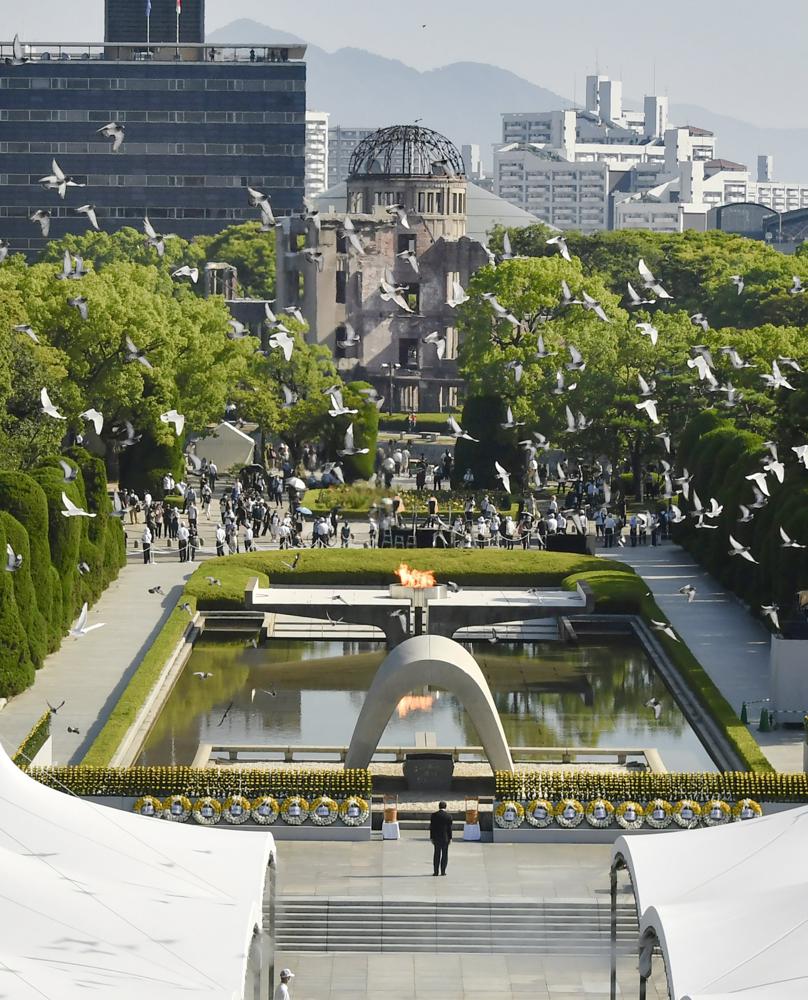
“I returned to civilization shortly after that and went to Cornell to teach, and my first impression was a very strange one. (…) I sat in a restaurant in New York, for example, and I looked out at the buildings and I began to think, you know, about how much the radius of the Hiroshima bomb damage was and so forth. (…) I would see people building a bridge, or they’d be making a new road, and I thought, they’re crazy, they just don’t understand, they don’t understand. Why are they making new things? It’s so useless.”
Richard Feynman
Nobel Prize in Physics (1965)
 Intel Today