
“The truth is—as this deplorable experience proves—that constitutions and laws are not sufficient of themselves…Despite the unequivocal language of the Constitution of the United States that the writ of habeas corpus shall not be suspended, and despite the Fifth Amendment’s command that no person shall be deprived of life, liberty or property without due process of law, both of these constitutional safeguards were denied by military action under Executive Order 9066.”
Former Supreme Court Justice Tom C. Clark — “Executive Order 9066: The Internment of 110,000 Japanese Americans”
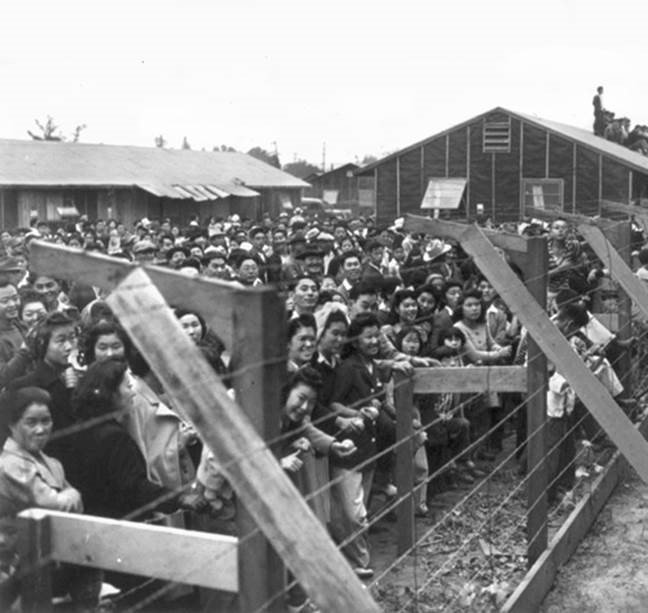
On February 19 1942, US President Roosevelt signed executive order 9066 which allowed regional military commanders to designate “military areas” from which any or all persons may be excluded. Follow us on Twitter: @INTEL_TODAY
RELATED POST: Remembering Hiroshima (August 6 1945)
RELATED POST: On This Day — Russia Spy Richard Sorge Arrested in Tokyo (October 18 1941)
RELATED POST: On This Day — John Keats : “When I Have Fears” (January 30 1818)
RELATED POST: On This Day — Einstein Letter to FDR (October 11 1939)
This authority was used to declare that all people of Japanese ancestry were excluded from the West Coast, including all of California and parts of Oregon, Washington, and Arizona, except for those in government camps.
Of 127,000 Japanese Americans living in the continental United States at the time of the Pearl Harbor attack, 112,000 resided on the West Coast.
About 80,000 were Nisei (literal translation: “second generation”; American-born Japanese with U.S. citizenship) and Sansei (“third generation”; the children of Nisei). The rest were Issei (“first generation”) immigrants born in Japan who were ineligible for U.S. citizenship under U.S. law.
The United States Census Bureau assisted the internment efforts by spying and providing confidential neighborhood information on Japanese Americans. The Bureau denied its role for decades, but it became public in 2007.
In 1944, the U.S. Supreme Court upheld the constitutionality of the removal by ruling against Fred Korematsu’s appeal for violating an exclusion order. The Court limited its decision to the validity of the exclusion orders, avoiding the issue of the incarceration of U.S. citizens without due process.
In 1980, under mounting pressure from the Japanese American Citizens League and redress organizations, President Jimmy Carter opened an investigation to determine whether the decision to put Japanese Americans into concentration camps had been justified by the government.
He appointed the Commission on Wartime Relocation and Internment of Civilians (CWRIC) to investigate the camps. The Commission’s report, titled Personal Justice Denied, found little evidence of Japanese disloyalty at the time and concluded that the incarceration had been the product of racism. It recommended that the government pay reparations to the internees.
In 1988, President Ronald Reagan signed into law the Civil Liberties Act of 1988 which apologized for the internment on behalf of the U.S. government and authorized a payment of $20,000 (equivalent to $42,000 in 2018) to each camp survivor.
The legislation admitted that government actions were based on “race prejudice, war hysteria, and a failure of political leadership.”
Japanese American Internment During WWII
REFERENCES
Internment of Japanese Americans — Wikipedia
=
On This Day — President Roosevelt Orders Internment of Japanese Americans (February 19 1942)
 Intel Today