
“There would be no place to hide. If this government ever became a tyranny… the technological capacity that the intelligence community has given the government could enable it to impose total tyranny, and there would be no way to fight back.”
Senator Frank Church
(1975)
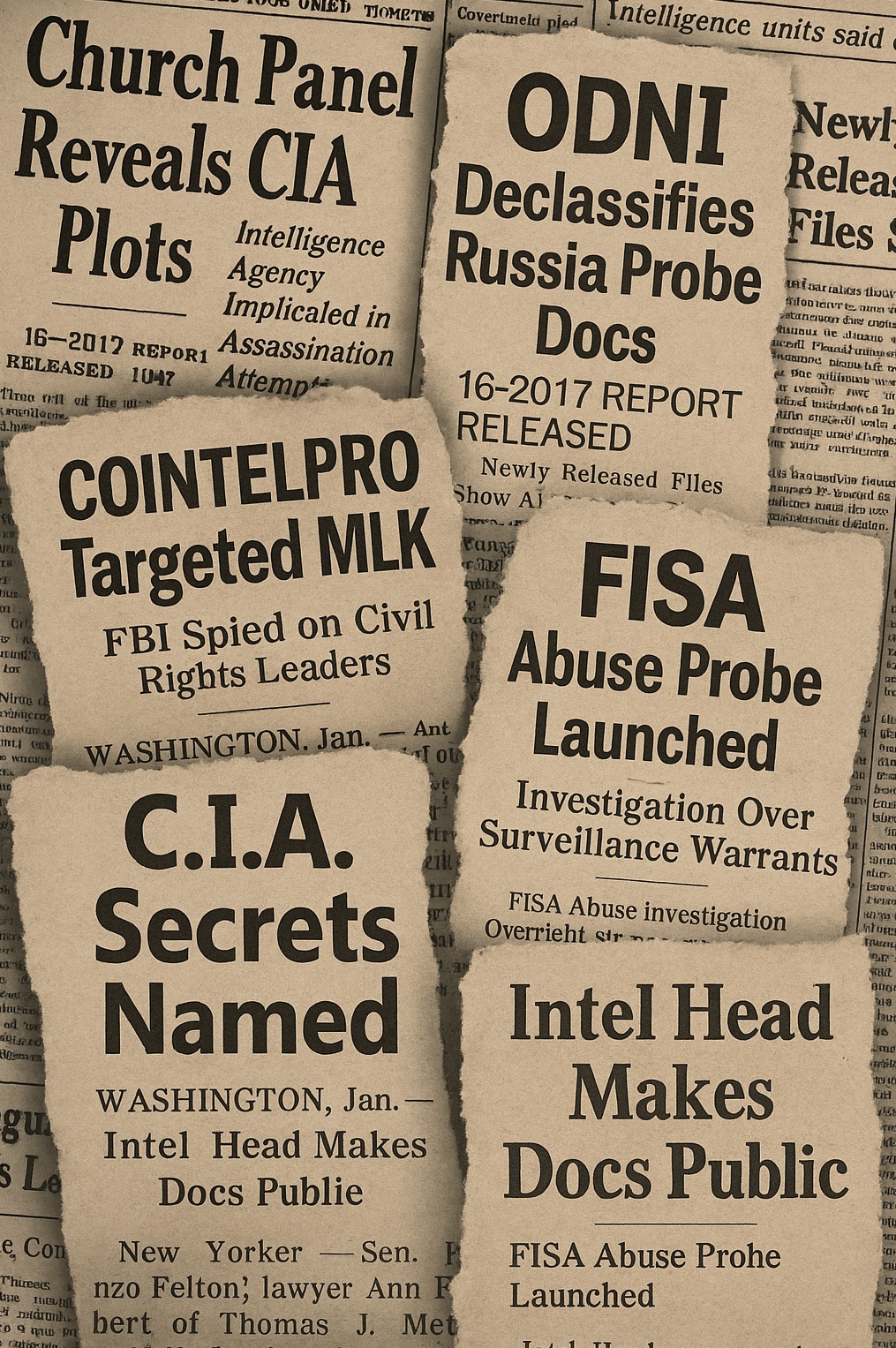
July 24, 2025 — In 1975, the Church Committee exposed two decades of covert abuses by U.S. intelligence agencies. Half a century later, 2025 is shaping up to be a sequel few expected—and no one dares to name. With newly declassified documents from the Office of the Director of National Intelligence, a Justice Department probe, and mounting claims that the intelligence community manipulated the 2016 election narrative for political ends, Washington is once again reckoning with the power of the spy apparatus at home.
Back then, it was wiretaps, blackmail, assassinations, and secret wars. Today, it’s the weaponization of intelligence—FISA warrants, cyber surveillance, and information warfare. Once again, the trust between citizens and the “deep state” is fractured. The tools have changed, but the questions are hauntingly familiar: Who holds the intelligence agencies accountable? And once again, we the people are forced to ask: Who watches the watchers? Follow us on X (formerly Twitter): @Intel_Today
RELATED POST : 1975: The Year of Intelligence [What the Church and Pike Investigations Revealed — and Why Their Warnings Still Matter]
RELATED POST : Revisiting Havana Syndrome: Moscow Death Ray vs. CIA Hoax [UPDATE : The Case Against John Brennan]
“The American people were misled. The FBI knew it wasn’t terrorism but continued to behave as though it were. That hurt public confidence and delayed the truth.”
Senator Chuck Grassley
Senate oversight hearings on the FBI and TWA 800
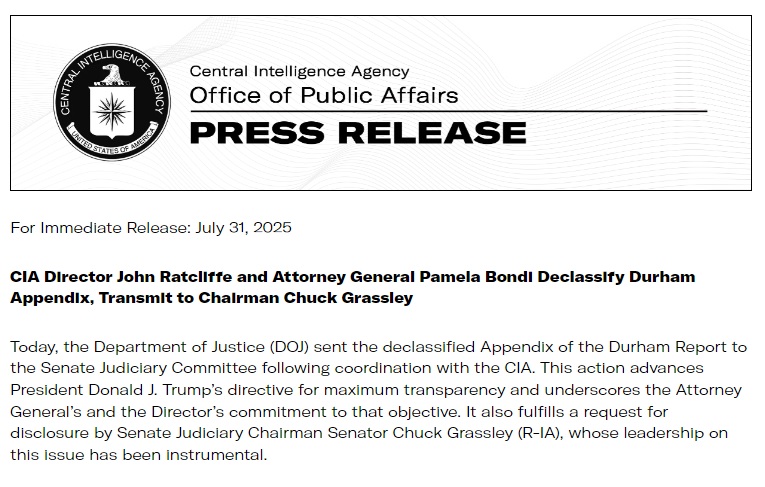
UPDATE (August 1, 2025) — This week, the CIA, FBI, and DOJ took a significant step toward transparency by declassifying the Durham Report’s appendix and transmitting it to Senator Chuck Grassley.
This move opens the door to renewed scrutiny of the FBI’s role in politically charged investigations — inviting us to revisit past episodes where the bureau’s control over the narrative had profound consequences.
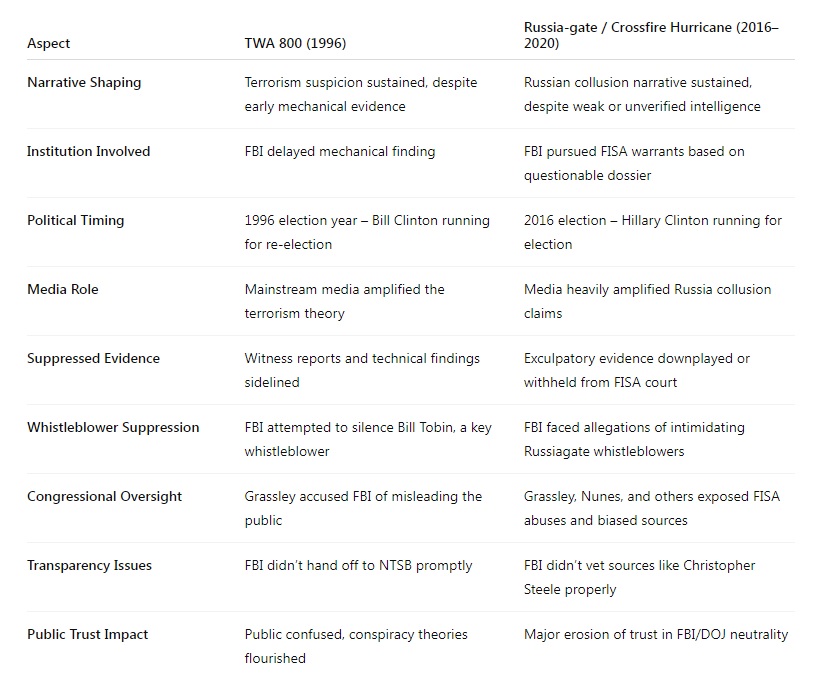
From the delayed truth surrounding TWA 800 to the sprawling Russiagate saga, a pattern emerges: the shaping of stories that serve institutional and political interests, often at the expense of the public’s right to know.
Take a look at the striking similarities between these two cases, nearly 30 years apart. Is it really just a coincidence — or is there a deliberate pattern in how powerful institutions manage the narrative?
Whistleblower Suppression: A Troubling Common Thread
In both the TWA 800 investigation and the Russiagate saga, the FBI reportedly attempted to silence key whistleblowers who challenged the official narratives. Bill Tobin, the TWA 800 whistleblower, claimed the FBI tried to suppress his testimony pointing to mechanical failure rather than terrorism.
Similarly, during Russiagate, multiple whistleblowers and insiders who raised concerns about biased investigative practices and flawed evidence faced intimidation or dismissal.
This recurring pattern raises serious questions about the FBI’s willingness to allow transparency when institutional or political interests are at stake.
Why This Matters: Grassley’s Push for Reform
This pattern of whistleblower suppression and narrative control is precisely why Senator Chuck Grassley has consistently pushed — and will continue to push — for FBI and DOJ reforms.
His oversight has spotlighted how these agencies sometimes prioritize institutional protection over truth and accountability.
The recent declassification of the Durham Report appendix gives Grassley renewed leverage to demand transparency and safeguards that protect whistleblowers and ensure the public receives an honest account — not just a politically convenient one.
END of UPDATE
“James K. Kallstrom projects confidence and determination. That is what was needed of the head of the F.B.I.’s New York office, and that is what was needed by the head of the T.W.A. Flight 800 investigation.”
Joseph R. Biden
2025: The Year of Intelligence 2.0 ?
50 Years from the Church Committee to Russiagate Investigation
Fifty years later, those same questions have resurfaced—more urgent, more complex, and more digitally entangled than ever before.
Once again, the intelligence community finds itself at the center of controversy, this time not over coups or covert wars, but over the alleged politicization of information, surveillance of domestic political figures, and manipulation of public perception.
At the heart of the current storm is the claim that intelligence tools originally designed to protect the republic were turned inward—used not merely to detect threats, but to shape electoral narratives, sway media coverage, and target political opponents.
Declassified documents released by the Office of the Director of National Intelligence (ODNI), alongside a Justice Department investigation into potential FISA abuses, have reignited a national debate over the proper boundaries of intelligence power in a democratic society.
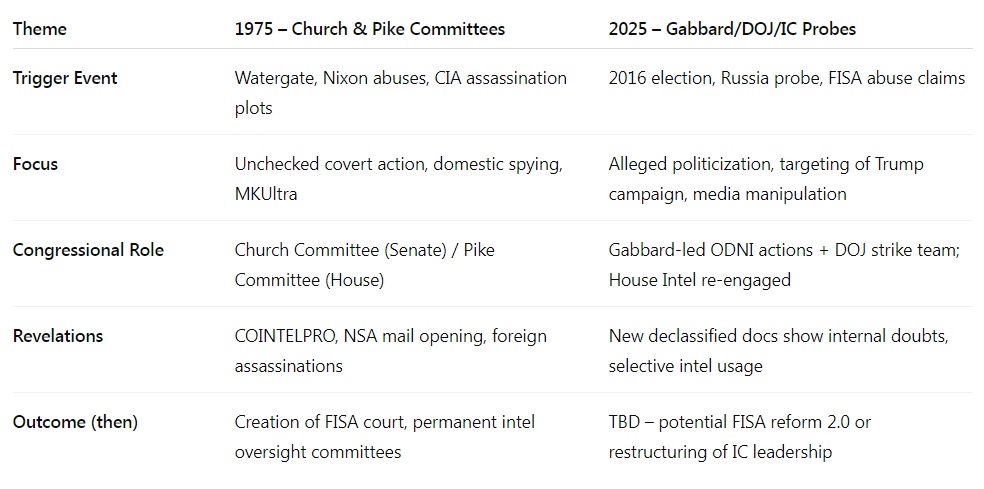
The parallels are striking. Then it was the CIA’s operations in Chile and the FBI’s COINTELPRO program; now it is questions about FISA warrants, cyber surveillance, and the weaponization of information.
Then, Congress responded with public hearings and structural reforms. Today, many wonder whether the mechanisms of accountability still function—or whether secrecy, bureaucracy, and polarization have rendered them inert.
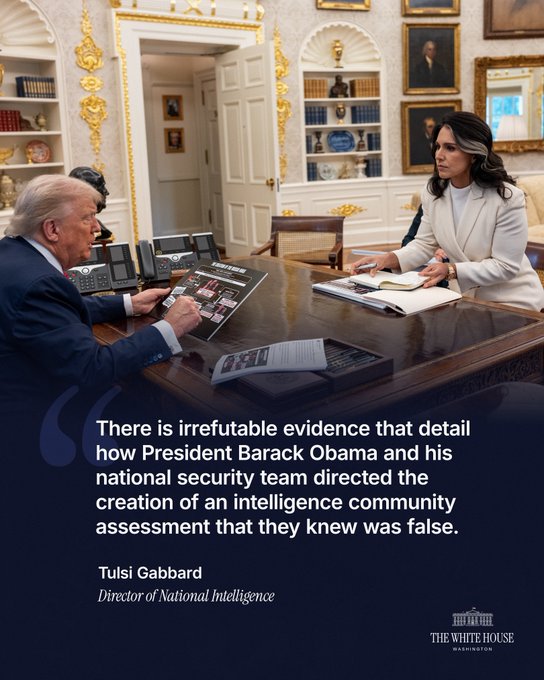
“The documents contain irrefutable evidence that details how President Obama and his national security team directed the creation of an intelligence community assessment that they knew was false.”
DNI Tulsi Gabbard
Heading for a Church Committee 2.0?
As revelations pile up and public trust in the intelligence community continues to erode, a growing chorus in Washington—and beyond—is calling for a new independent investigation modeled on the Church Committee of 1975.
Lawmakers across the political spectrum, civil liberties advocates, and former intelligence officials have begun to acknowledge what was once unthinkable: that the institutions designed to protect democracy may themselves require renewed oversight and structural reform.
Spearheading this new wave of scrutiny is Director of National Intelligence Tulsi Gabbard, whose decision to declassify a cache of sensitive documents from the 2016–2017 period has reignited long-standing allegations that intelligence leaders shaped narratives around foreign election interference to serve domestic political ends.
The Justice Department has since launched a formal probe into possible FISA abuses and the broader question of intelligence “weaponization”—marking one of the most serious internal reckonings the intelligence community has faced in decades.
50 years ago, Frank Church warned the American people:
“I know the capacity that is there to make tyranny total in America, and we must see to it that this agency [CIA] and all agencies that possess this technology operate within the law and under proper supervision, so that we never cross over that abyss. That is the abyss from which there is no return.”
But is Washington truly prepared to revisit the kind of sweeping inquiry last seen in 1975? A modern-day Church Committee would require bipartisan courage, institutional humility, and an unwavering commitment to transparency—qualities in short supply in today’s hyper-polarized political landscape.
Still, the stakes are undeniable: if left unexamined, the erosion of public trust in intelligence may become more damaging than any foreign threat.
“He who fights with monsters should be careful lest he thereby become a monster. And if you gaze long enough into an abyss, the abyss also gazes into you.”
Friedrich Nietzsche
(Beyond Good and Evil)
REFERENCES
Gabbard declassifies new docs in latest push to cast doubt on Russia assessment — Politico
Justice Department to assess claims of ‘alleged weaponization’ of US intelligence community — Reuters
Speaking about ECHELON, Frank Church said:
“…[T]hat capability at any time could be turned around on the American people and no American would have any privacy left, such [is] the capability to monitor everything: telephone conversations, telegrams, it doesn’t matter. There would be no place to hide. If this government ever became a tyranny, if a dictator ever took charge in this country, the technological capacity that the intelligence community has given the government could enable it to impose total tyranny, and there would be no way to fight back, because the most careful effort to combine together in resistance to the government, no matter how privately it was done, is within the reach of the government to know. Such is the capability of this technology … I don’t want to see this country ever go across the bridge. I know the capacity that is there to make tyranny total in America, and we must see to it that this agency and all agencies that possess this technology operate within the law and under proper supervision, so that we never cross over that abyss. That is the abyss from which there is no return.”
=
2025: The Year of Intelligence 2.0 ? [50 Years from the Church Committee to Russiagate Investigation]
 Intel Today
Not sure where the government will ‘need’ to [re] take the TWA 800 crash investigation, when they ”ignored” the findings in [Ray Lahr V NTSB] and the irrevocable evidence for a missile impact, according to the investigators. However, the case is not actually as ”complicated” as many required it be, though requiring it to be so, in order to further confuse the case… Do know that by way of the air traffic transcripts, the radar, and some court docs in LAHR, and then several FOIA documents, the case IS now solved. You can listen on I-Heart radio @
spreaker/aaron sheets twa flight 800 solved
This is ‘not’ what many people want to hear. That the case is solved, and with bona fides.
For others, their Books have been written, their Video’s have been made. But now that the Only Truth is out, well…. you cant un ring that bell.
Aaron Sheets
LikeLike