
“As I told the Prime Minister the last time, he vastly overestimates the competence of the CIA.”
Henri Kissinger
(Answer to Zhou Enlai about the US involvement in the bombing of the Kashmir Princess)
April 11 2024 — On April 11 1955, the Kashmir Princess — a chartered Lockheed L-749A Constellation aircraft owned by Air India — was damaged in mid-air by a bomb explosion. The plane crashed into the South China Sea while en route from Hong Kong to Jakarta, Indonesia. Sixteen of those on board were killed, while three survived. The target of the assassination was non other than the Chinese Premier, Zhou Enlai. Follow us on Twitter: @Intel_Today
RELATED POST: Nixon Goes To China [Humour]
RELATED POST: 70 Years Ago — Did Richard Nixon Frame Alger Hiss? [Dec. 6 1948 – The Pumpkin Papers]
RELATED POST: On This Day — Nixon Announces Vietnam Peace Agreement (January 23, 1973) [Was Nixon a Traitor?]
RELATED POST: On This Day — Nixon Dismisses CIA Director Richard Helms (February 2 1973)
RELATED POST: Historian Webster Tarpley: Nixon Was Ousted By The CIA
RELATED POST: Blast From The Past: Nixon & the CIA’s Daily Briefs
“I was the CIA director. We lied, we cheated, we stole. It’s – it was like – we had entire training courses. It reminds you of the glory of the American experiment.”
CIA Director Mike Pompeo
Texas A&M University
(April 15, 2019)
UPDATE (April 11 2024) — ‘Truth seeding’ is a common tactic employed by intelligence agencies and other entities engaging in disinformation campaigns.
This approach involves incorporating genuine elements or events into fabricated narratives to lend them credibility.
[Did you know? Ian Fleming was an English author, journalist and naval intelligence officer who is best known for his James Bond series of spy novels. Before writing the series, Fleming co-authored some fantastic pieces of disinformation, including Operation Mincemeat.]
By grounding the false information in reality, it becomes more convincing to the target audience. There are several reasons why this tactic is effective:
— Plausibility: By using real events or facts as the foundation, the fabricated story appears more plausible to the audience. People are more likely to believe information that aligns with their existing knowledge or experiences.
— Credibility: Genuine elements lend credibility to the false narrative, as they are often easier to verify. This can make it more challenging for observers to distinguish between fact and fiction.
— Misdirection: By focusing attention on real events, intelligence agencies can divert scrutiny away from their own activities or true intentions. This can confuse adversaries or obscure the origin of the disinformation.
— Exploiting biases: People tend to trust information that confirms their existing beliefs or biases. By incorporating real events into false narratives, disinformation campaigns can exploit these biases to manipulate public opinion.
However, while truth seeding can make disinformation more effective, it’s not foolproof. Skilled analysts and investigators can still uncover inconsistencies or discrepancies within the fabricated story, especially with careful fact-checking and analysis.
RELATED POST : Lockerbie – Three Decades of Lies: J’Accuse…! [Chapter VIII : PT/35(b) — The Most Expensive Forgery in History]
Additionally, over-reliance on this tactic can potentially erode trust over time if the audience becomes aware of deliberate attempts to manipulate information.
RELATED POST : On This Day — President Truman Creates the Central Intelligence Group (January 22, 1946) [Gallup Poll : Americans’ rating of the CIA]
The successful investigation of the ‘Kashmir Princess’ crime and the identification of its culprits was possible because of the recovery of some part of the detonator device.
That lesson was not lost on the CIA. When the boys from Langley wrote the Lockerbie script, they used this ‘seed of truth’ to implicate Libya.
RELATED POST : Do you have what it takes to be an FBI Intelligence Analyst? [Parody]
All they had to do was to plant a tiny fragment of a Swiss timer that had been specifically produced for and uniquely delivered to Tripoli. The rest is History…
END of UPDATE
“Fingers began pointing at the Central Intelligence Agency as the possible culprit. (…) Undoubtedly, the CIA had supplied MK-7 triggers to Taiwan.”
UPDATE (April 11 2023) — Just ask ChatGPT! — This morning, I sent a rather simple question to ChatGPT: “Greetings! Do you know Who was responsible for the Bombing of the Kashmir Princess?”
Here is the answer:
“Yes, the bombing of the Kashmir Princess was a terrorist attack that took place on 11th April 1955.
It was an attempt to assassinate the then Prime Minister of China, Zhou Enlai, who was scheduled to travel on the Kashmir Princess. However, the plot was unsuccessful as Zhou Enlai did not board the plane.
The responsibility for the bombing was initially attributed to Indian intelligence agencies, but it was later discovered that the CIA was involved in the plot.
The agency had worked with Taiwanese intelligence to carry out the bombing, as they believed that Zhou Enlai’s visit to Southeast Asia would strengthen China’s influence in the region.
The incident caused a significant diplomatic fallout, and it led to strained relations between China and the United States for many years.”
What do you think?
END of UPDATE
“Evidence now suggests that Zhou knew of the plot beforehand and secretly changed his travel plans, though he did not stop a decoy delegation of lesser cadres from taking his place.”
Professor Steve Tsang
Oxford University
The China Quarterly (September 1994)
Zhou Enlai was expected to be on board. He had planned to fly from Beijing to Hong Kong and then to Jakarta on the ‘Kashmir Princess’ but an emergency appendectomy delayed his arrival in Hong Kong by several days.
From the outset, China accused the United States of involvement in the bombing.
The day after the crash, China’s Foreign Ministry issued a statement that described the bombing as “a murder by the special service organizations of the United States and Chiang Kai-shek”
On the same day, Hong Kong Governor Sir Alexander Grantham stated that the plane had not been not tampered with in Hong Kong.
However, on May 26 1955, an Indonesian board of inquiry announced that a time bomb — with an American-made MK-7 detonator — was responsible for the crash.
The investigators concluded that it was highly probable that the bomb had been placed on the plane in Hong Kong.
The Mystery of Chow Tse-Ming
“As investigators and police chased leads about Chow Tse-Ming, they began to unravel a mystery.
Apparently, Chow Tse-Ming was an alias; in fact, two other aliases for the same man were also uncovered.
As well, in the days leading up to the bombing and crash of the plane, they learned that Chow Tse-Ming had been spending a lot of money around Hong Kong, as if living it up based on income or savings that an airport janitor shouldn’t reasonably have.
Perhaps he had been paid to plant the bomb? Finally, his disappearance from Hong Kong was traced to him having departed quietly on a Civil Air Transport (CAT) flight to Taiwan.
As the Chinese knew all too well, CAT was a frequent CIA contract air carrier, though it also flew other airline operations and cargo flights around the region.
Fingers began pointing at the Central Intelligence Agency as the possible culprit, though a competing theory soon emerged when others considered that the CAT flight had delivered Chow Tse-Ming to Taiwan.
Indonesian investigators reported that amidst the wreckage, they had identified an American-made MK-7 detonator device, adding fuel to the fire.
The British-run Hong Kong police surmised that it seemed likely that the man was an agent of the Kuomintang’s intelligence operations arm, a theory which the Chinese also felt had validity. Undoubtedly, the CIA had supplied MK-7 triggers to Taiwan.” [Flights Stories]
CIA plans existed… But they were disapproved
While the CIA had considered a plan to assassinate Zhou Enlai at this time, the Church Committee reported that these plans were disapproved of and “strongly censured” by Washington.
In a 1971 face-to-face meeting in the Great Hall of the People in Beijing, Zhou Enlai directly asked Henry Kissinger about the alleged US involvement in the bombing. Kissinger responded:
“As I told the Prime Minister the last time, he vastly overestimates the competence of the CIA.”
“Years later, Thurman admitted that he had been instructed by the FBI to lie about the Lockerbie timer to a Grand Jury in order to cover up for the role of the CIA.”
Post-Scriptum
The successful investigation of the ‘Kashmir Princess’ crime and the identification of its culprits was possible because of the recovery of some part of the detonator device.
That story was not lost on the CIA and other American spooks.
In the late 80s, the US Intelligence Community ‘miraculously’ identified twice Libya as the culprit of airliner bombings thanks to the investigation of a tiny part of the detonators: a Swiss timer — known as the MST-13 — in the case of Pan Am 103 (December 21, 1988) and a Taiwanese timer in the UTA 772 bombing (September 19, 1989).
In both cases, these timers were ‘unambiguously’ linked to Libya’s Gaddafi.
In both cases, the identification was made by the same FBI investigator — Tom Thurman — who was later discredited for altering official reports.
And by the way, this FBI agent had not scientific qualifications whatsoever.
“It is striking to note the similarity of the ‘scientific’ evidence discovered by the FBI’s Tom Thurman in both the Lockerbie and UTA cases.
Of the tens of thousands of pieces of debris collected at each disaster site, one lone piece of printed circuit was found and, miracle of miracles, in each case the fragment bore markings that allowed for positive identification: MEBO in the Lockerbie case and TY in the case of UTA Flight 772.
Despite the common findings of the DCPJ, the DST and the Prefecture of Police crime laboratory, Juge Bruguière chose to believe Thurman, the expert in fabricating evidence.” [French journalist Pierre Péan — “African Manipulations”]
Years later, Thurman admitted that he had been instructed by the FBI to lie about the Lockerbie timer to a Grand Jury in order to cover up for the role of the CIA.
RELATED POST: Suspicious Aviation Tragedies — November 27 1989 : Avianca Flight 203 [UPDATE (Spanish) : Simon Bolivar Prize 2017]
RELATED POST: Suspicious Aviation Tragedies: 1989 — UTA Flight 772 (September 19 1989)
RELATED POST: One Year Ago — The Washington Post rewrites History [Lockerbie]
One of Thurman’s student and ‘protégé’ — Former FBI Rick Hahn — investigated the crash of Avianca 203 (November 27, 1989) and concluded that the Colombian plane had been destroyed by a bomb on the order of Pablo Escobar.
A recent investigation concluded that the crash was due to mechanical failure. Again, that agent had not scientific qualifications.
After several years of inquiry, the US DOJ ordered these two agents, as well as any other individual without proper scientific qualifications, out of the FBI explosion Unit. Never too late…
Prime Minister Jawahar Lal Nehru receives Chinese Minister Chou En-Lai
REFERENCES
Assassination via the Kashmir Princess — Flights Stories
=
On This Day — Target Zhou Enlai : The Bombing of the “Kashmir Princess” (April 11 1955)
On This Day — Target Zhou Enlai : The Bombing of the “Kashmir Princess” (April 11 1955) [UPDATE : Just ask ChatGPT!]
==
UPDATE (January 8 2024) — Zhou Enlai (Chinese: 周恩来; 5 March 1898 – 8 January 1976) was a Chinese statesman, diplomat, and revolutionary who served as the first Premier of the People’s Republic of China from September 1954 until his death on January 8 1976.
U.S. Secretary of State Henry Kissinger had a deep respect and real admiration for Zhou Enlai.
“Zhou Enlai was the most impressive man I ever met. His commands of facts, in particular his knowledge of American events and, for that matter, of my own background, was stunning. His intellect was very high. He was a man of extraordinary breadth. He carried the weight of China, a country that was just recovering from a century of humiliation. And he dealt with foreign ministers who were often arrogant and thought they had a right to demand everything but that he had no right to ask for anything. He dealt with them with extraordinary skill. He was, I think, a truly great man.”
There is no doubt whatsoever that Zhou Enlai is one of the most formidable politicians in recent history. There are several aspects that may have contributed to Kissinger’s admiration:
Diplomacy and Statesmanship: Zhou Enlai was known for his diplomatic skills and statesmanship. He played a crucial role in the normalization of relations between the United States and China during the early 1970s. Kissinger and Zhou worked closely on the opening of diplomatic channels between the two nations, which eventually led to President Richard Nixon’s historic visit to China in 1972.
Calm and Strategic Thinking: Zhou Enlai was often praised for his calm and composed demeanor, even in the face of complex and challenging international situations. This quality might have impressed Kissinger, especially given the intense geopolitical climate during the Cold War.
Intellectual Depth: Zhou Enlai was known for his intellectual depth and understanding of world affairs. His insights into global politics and his ability to engage in thoughtful discussions may have left a lasting impression on Kissinger, who himself was a highly educated and intellectual figure.
Long-Term Vision: Zhou Enlai was recognized for his long-term vision and strategic thinking. He played a crucial role in shaping China’s foreign policy and domestic development. Kissinger, as a diplomat and strategist, may have appreciated Zhou’s ability to think beyond immediate circumstances.
Personal Interaction: Personal chemistry and mutual respect often play a significant role in diplomatic relationships. Kissinger and Zhou had multiple meetings and interactions during a critical period in international relations. The personal rapport they developed could have influenced Kissinger’s positive assessment of Zhou Enlai.
And make no mistakes. Zhou Enlai had a very negative opinion of America. “In fact, Zhou Enlai was ideologically very hostile to us and had he lived, in the long evolution of history, in 20 years we might again find ourselves on opposite sides,” Kissinger told Dick Cavett.
Here is a story that may shock a few readers. During the preparation of Nixon’s visit to China, Kissinger and Zhou Enlai discussed the very sticky issue of Taiwan. Kissinger suggested that history would be on the side of China’s claim for the island, a position completely at odds with American policy.
Kissinger described him as “equally at home in philosophy, reminiscence, historical analysis, tactical probes, a well as humorous repartee.”
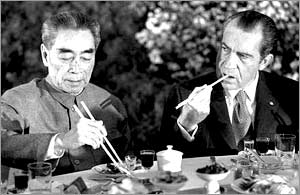
The following discussion between Nixon and Zhou Enlai will demonstrate the quality of his humorous repartee.
Nixon: History is a hell of a thing. Isn’t it Mr. General Secretary? For example, I once ran for president against a guy called John Kennedy.
Zhou Enlai: Yes, we know that Mr. President.
Nixon: And he beat me, you know.
Zhou Enlai: Yes, we heard that here too.
Nixon: And then — by now the perspiration is dripping from his forehead — not long after, the man who beat me was killed, cut down by an assassin’s bullet.
Zhou Enlai: Yes, we saw that too.
Nixon: But now imagine that the same bullet had instead killed the Soviet Premier Nikita Khrushchev. Do you think that History would have been really any different? Not at all, I say!
Zhou Enlai: Actually I can think of something that would have been really different.
Nixon: And what would that be?
Zhou Enlai: I don’t think Aristotle Onassis would have married Mrs. Khrushchev.
In a letter to a friend, Dag Hammarskjöld wrote:
“It is a little bit humiliating when I have to say that Chou En-lai to me appears as the most superior brain I have so far met in the field of foreign politics… so much more dangerous than you imagine because he is so much better a man than you have ever admitted.”
END of UPDATE
“Zhou Enlai was a man of extraordinary intelligence, one of the most intelligent people I’ve ever met.”
Henry Kissinger
 Intel Today