
“Numbers read on state radio may be cold war-era method of sending coded messages to spies in South Korea – or an attempt to wage psychological warfare.”

Last year (2016), North Korea reactivated its ‘numbers station’. And now, V15 transmits on FM! Follow us on Twitter: Intel_Today
RELATED POST: CIA Establishes Korea Mission Center
RELATED POST: Significant Uncertainties in the Yield Estimate of North Korea H Bomb
RELATED POST: NORTH KOREA Claims to Have Successfully Tested H-Bomb [UPDATE — First estimate of the Yield]
RELATED POST: A SCIENTIFIC ANALYSIS OF NORTH KOREA SECOND NUCLEAR TEST (May 25 2009)
On December 21st, 2016, North Korea decided to change some frequencies from their main broadcast stations.
“This includes Echo of Hope and Radio Pyongyang, among others. In the case of Radio Pyongyang, they dropped three MW frequencies (684, 729 and 1080 kHz), and they started to broadcast on FM! And not only on one frequency, but four!” [PRIYOM]
2nd Number Broadcast This Year
For the 22nd time since June of last year, North Korea broadcast random numbers Friday (13 January 2017) believed to be coded instructions to spies.
The string of numbers recited by the Pyongyang Broadcasting Station anchor were a new sequence that monitors have not heard before..
This is the second such broadcast by the North in 2017, following the first last Sunday (1 January 2017). [KBS World Radio]
Typical Broadcast
The 12-minute broadcast began shortly after midnight on 15 July 2016 with a female voice saying:
“I will give review work to No. 27 exploration agents.”
The announcer then read:
“On page 459 number 35, on page 913 number 55, on page 135 number 86, on page 257 number (0)2,” and so on.
RELATED POST: Radio Pyongyang resurrects ‘NUMBERS STATION’
What do the numbers mean?
The agent is equipped with a key and a ‘book’ of cypher pads. Then, he receives a message such as this one:
64056
92478
14417
23755
The first 5 digits tells him which pad to use. So in this case: ‘pad’ 64056.
64056
34589
56780
06653
…
Now, the agent must subtract the message from the pad.
64056 34589 56780 06653
64056 92478 14417 23755
The result is:
00000 42111 42373 83908
Now the agent has the real, but coded, message. [Please, note that only a person having access to this unique cypher pad can access the message.]
Now, how to decode the message? Here is the ‘common’ key provided to the agent.
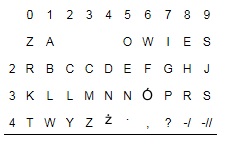
According to the table of the key, the digits 2, 3, and 4 are matched with the digits following them. So the message actually reads:
00000 42 111 42 37 38 39 0 8
which the agent decodes as:
00000 42 111 42 37 38 39 0 8
00000 Y 111 Y P R S Z E
Now, the numbers or names are repeated three times and are clasped in between two Y.
So the message is :
1 PRSZE
Which a person familiar with the language (PROSZE means Please in Polish) readily understands as : “N°1 , Please.”
NB: This is actually a real common key code used by the BND (and thus the Americans) to communicate with their (non-German speaking) agents in Poland during the cold war. Notice a ‘mistake’ in the key. The letter ‘U’ is missing. This is probably a typing mistake. They were not at all uncommon.
Numbers Station in Pop Culture
The Numbers Station is a 2013 action thriller film, starring John Cusack and Malin Akerman, about a burned-out CIA black ops agent assigned to protect the code operator at a secret American numbers station somewhere in the British countryside.
REFERENCES
North Korea is criticised by South Korea for ‘spy broadcasts’ BBC 20 July 2016
North Korea resumes Cold-War-era radio broadcasts for its spies abroad IntelNews
The spooky world of the ‘numbers stations’
North Korea’s radio broadcast of string of mysterious numbers is possible code The Guardian 19 July 216
N. Korea Transmits 2nd Number Broadcast This Year — KBS World Radio 13 January 2017
=
Radio Pyongyang Resurrects its ‘NUMBERS STATION’. How does it work anyway?
One Year Ago — Radio Pyongyang Resurrects its ‘NUMBERS STATION’. How does it work anyway?
 Intel Today
The external service I believe is called “Voice of Korea” now. It was Radio Pyongyang until 2002. While working as a journalist in the 1990s, I profiled Radio Pyongyang and KBS. See link; https://schanowitz.wixsite.com/website/single-post/2017/07/17/Links-to-best-International-articles-I-published-while-working-in-Finland
LikeLike